Why do some people feel comfortable with closeness while others pull away? Why do certain relationship conflicts feel deeply emotional, even when the issue seems small? Attachment styles offer a psychology-based framework for understanding these patterns.
Attachment styles describe how people emotionally bond, respond to intimacy, and manage closeness and distance in relationships. They influence how we communicate needs, react to conflict, experience trust, and regulate emotions often outside conscious awareness. While attachment theory originated in childhood research, decades of evidence now show that attachment patterns remain highly relevant in adult romantic relationships, friendships, and even workplace dynamics.
Understanding attachment styles does not label people as “good” or “bad partners.” Instead, it provides a lens for understanding why relationship behaviors make sense given a person’s emotional history—and how change is possible.
The Psychological Origins of Attachment Theory
Attachment theory was first developed by John Bowlby, a British psychiatrist and psychoanalyst. Bowlby proposed that human beings are biologically wired to seek closeness to caregivers during times of distress. This attachment system evolved as a survival mechanism, ensuring protection, safety, and emotional regulation during early development.
Bowlby emphasized that children form internal expectations called internal working models about relationships based on how caregivers respond to their needs. These models shape beliefs such as:
- Are others reliable and emotionally available?
- Am I worthy of care and attention?
Later, developmental psychologist Mary Ainsworth expanded Bowlby’s work through observational research, most notably the “Strange Situation” experiments. Her findings identified consistent patterns in how infants responded to separation and reunion with caregivers, laying the groundwork for what we now call attachment styles.
A key concept from this research is the secure base: when caregivers are consistently responsive, children feel safe enough to explore the world while knowing support is available if needed. This balance between autonomy and connection becomes central to healthy relationships across the lifespan.
What Are Attachment Styles?
Attachment styles are habitual patterns of emotional regulation, closeness-seeking, and trust that develop in response to early caregiving experiences and later relational experiences. They reflect how the attachment system activates under stress particularly in close relationships.
Broadly, attachment styles are divided into:
- Secure attachment
- Insecure attachment, which includes anxious, avoidant, and disorganized patterns
Importantly, attachment styles are not personality traits. They are adaptive strategies shaped by experience. A child who learns that care is inconsistent may become hyper-aware of relational cues, while one who learns that emotional needs are dismissed may downplay closeness to protect themselves. These strategies were once protective—even if they later create challenges in adult relationships.
Also read: Anxious Attachment: Signs, Causes, and Relationship Patterns
The Four Main Attachment Styles Explained
Secure Attachment
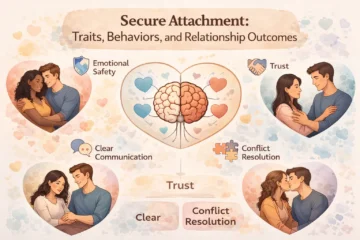
Securely attached individuals generally feel comfortable with intimacy and independence. They trust others, express needs directly, and regulate emotions effectively during conflict.
Common characteristics include:
- Comfort with emotional closeness
- Ability to communicate needs without fear
- Trust in partners’ availability
- Resilience during relationship stress
Secure attachment does not mean someone never feels anxious or distant it means they can return to emotional balance without extreme strategies.
Anxious Attachment
Anxious attachment is characterized by heightened sensitivity to relationship threats. Individuals may fear abandonment, rejection, or emotional withdrawal and often seek reassurance to feel safe.
Common patterns include:
- Strong desire for closeness and validation
- Worry about partner availability
- Emotional intensity during conflict
- Difficulty self-soothing when distressed
These behaviors often develop when caregiving was inconsistent—sometimes responsive, sometimes unavailable—leading the attachment system to stay “on high alert.”
Avoidant Attachment
Avoidant attachment involves discomfort with emotional dependence and vulnerability. Individuals often prioritize self-reliance and minimize emotional needs, especially under stress.
Typical characteristics include:
- Preference for independence over closeness
- Emotional distancing during conflict
- Discomfort with vulnerability
- Deactivation of attachment needs
Avoidant strategies often emerge when caregivers were emotionally unavailable or dismissive, teaching the child that relying on others is unsafe or ineffective.
Disorganized Attachment
Disorganized attachment reflects a lack of a consistent strategy for dealing with closeness and fear. It often combines anxious and avoidant tendencies and is linked to early experiences of unpredictability, fear, or trauma.
Common features include:
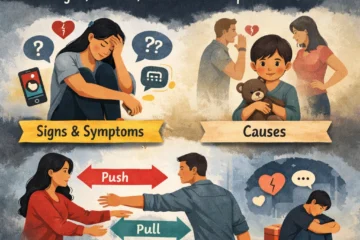
- Push-pull dynamics in relationships
- Desire for closeness paired with fear of intimacy
- Emotional volatility
- Difficulty trusting both self and others
Disorganized attachment is associated with caregiving environments that were simultaneously a source of comfort and fear, leaving the attachment system without a stable pattern.
Read more: What Attachment Styles Are and How They Shape Adult Relationships
How Attachment Styles Develop
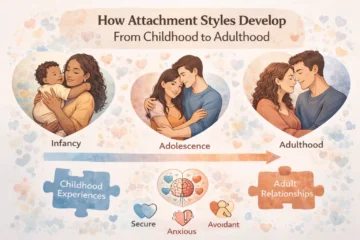
Attachment styles begin forming in early childhood through repeated interactions with caregivers. The key factors influencing attachment development include:
- Consistency: Are needs responded to reliably?
- Responsiveness: Are emotional cues noticed and validated?
- Safety: Is the environment emotionally and physically secure?
When caregivers respond predictably and sensitively, children learn that relationships are safe. When care is inconsistent, neglectful, or frightening, children adapt by intensifying, suppressing, or fragmenting attachment behaviors.
Importantly, attachment strategies are adaptive responses, not flaws. They reflect the best available solution a child had to maintain connection under given circumstances.
Attachment Styles in Adulthood
In adulthood, attachment styles primarily emerge in emotionally close relationships, especially romantic partnerships. Stress, conflict, or perceived rejection tend to activate attachment patterns most strongly.
Attachment may look different across relationship types:
- Romantic relationships often trigger attachment most intensely
- Friendships may show milder patterns
- Family relationships can reinforce or challenge early models
While attachment styles show stability over time, research consistently demonstrates that they are malleable. New experiences, supportive relationships, and intentional self-reflection can shift attachment security.
Common Misconceptions About Attachment Styles
“Attachment styles never change.”
Research shows attachment patterns can shift with corrective emotional experiences, therapy, and secure relationships.
“One partner causes the other’s attachment style.”
Attachment styles are internal patterns. Partners may trigger them, but they do not create them.
“Attachment styles explain everything.”
Attachment is one framework among many. Personality, trauma, culture, and context also matter.
“Attachment styles are the same as personality disorders.”
They are not diagnostic categories and should not be used to pathologize behavior.
Why Understanding Attachment Styles Is Helpful
Learning about attachment styles can:
- Increase emotional self-awareness
- Reduce shame around relationship patterns
- Improve communication and empathy
- Clarify recurring relational conflicts
- Support healthier boundaries and expectations
Rather than asking “What’s wrong with me or my partner?” attachment theory reframes the question as: What is my nervous system trying to protect?
When Attachment Styles Become a Problem
Attachment patterns can become problematic when they lead to:
- Chronic relationship distress
- Repeated cycles of conflict and withdrawal
- Emotional exhaustion or burnout
- Difficulty trusting or maintaining closeness
In these cases, working with a therapist trained in attachment-based or trauma-informed approaches can be beneficial. Therapy can help individuals build emotional regulation skills and develop more secure relational strategies.
Conclusion:
Attachment styles are best understood as patterns not identities. They explain how people learned to connect, not how they are destined to love forever. With awareness, supportive relationships, and intentional effort, attachment security can grow over time.
Understanding attachment styles provides a foundation for deeper self-knowledge and healthier relationships. It is not about assigning blame it is about creating clarity, compassion, and the possibility of change.
Frequently Asked Questions:
1.What are the four attachment styles?
The four main attachment styles are secure, anxious, avoidant, and disorganized. Secure attachment involves comfort with intimacy and independence, while the other three are considered insecure attachment patterns that develop in response to inconsistent, unavailable, or frightening caregiving.
2. How do I know my attachment style?
People often recognize their attachment style by noticing patterns in how they react to closeness, conflict, reassurance, and emotional distance in relationships. Formal attachment assessments or working with a therapist can provide more accurate insight than online quizzes alone.
3. Are attachment styles formed in childhood or adulthood?
Attachment styles typically begin forming in early childhood based on caregiver interactions. However, they can continue to evolve throughout adulthood in response to romantic relationships, therapy, and emotionally significant life experiences.
4. Can attachment styles change over time?
Yes. Research shows attachment styles are not fixed. With increased self-awareness, secure relationships, and therapeutic support, many people develop more secure attachment patterns over time.
5. What is the difference between anxious and avoidant attachment?
Anxious attachment is characterized by fear of abandonment and a strong need for reassurance, while avoidant attachment involves discomfort with emotional closeness and reliance on self-sufficiency. Both are strategies for managing relationship stress but operate in opposite ways.
6. Is disorganized attachment the same as anxious-avoidant attachment?
Disorganized attachment often includes both anxious and avoidant behaviors, but it is distinct in that it lacks a consistent strategy for seeking closeness or safety. It is commonly associated with early experiences of fear, unpredictability, or trauma.
7. Do attachment styles affect romantic relationships more than friendships?
Attachment styles tend to show up most strongly in romantic relationships because they activate deeper emotional vulnerability. However, attachment patterns can also influence close friendships, family relationships, and even workplace dynamics.
8.Can someone have more than one attachment style?
People may show different attachment patterns depending on the relationship or situation. While most individuals have a dominant attachment style, attachment is best understood as a spectrum rather than a single fixed category.
9. Are attachment styles linked to mental health conditions?
Attachment styles are not mental health diagnoses. However, insecure attachment patterns are associated with higher levels of anxiety, depression, and relationship distress, especially when combined with unresolved trauma or chronic stress.
10. Why are attachment styles important to understand?
Understanding attachment styles helps explain recurring relationship patterns, emotional reactions, and conflict behaviors. This awareness can improve communication, reduce self-blame, and support healthier, more secure relationships.
References
- Mikulincer, M., & Shaver, P. R. (2019). Attachment in Adulthood: Structure, Dynamics, and Change (2nd ed.). Guilford Press.
- Fraley, R. C., & Roisman, G. I. (2019). The development of adult attachment styles: Four lessons. Current Opinion in Psychology, 25, 26–30.
- Dagan, O., & Shaver, P. R. (2020). Attachment theory and emotion regulation. Current Opinion in Psychology, 25, 34–39.
- Raby, K. L., et al. (2020). The enduring predictive significance of early maternal sensitivity. Child Development, 91(4), 1216–1234.
- Simpson, J. A., & Overall, N. C. (2022). Attachment theory and close relationships. Annual Review of Psychology, 73, 1–28.