Over the past two decades, the language people use to describe romantic connections has expanded. Alongside terms like dating, exclusive, or committed relationship, newer labels have emerged to capture experiences that don’t fit neatly into older categories. One of the most widely used is situationship.
Rather than describing a specific relationship structure, the term points to something more abstract: ambiguity. Situationships are often defined less by what they are and more by what they lack—clear labels, shared expectations, or agreed-upon direction. Yet they are not rare or fringe experiences. Surveys and qualitative research suggest that ambiguous romantic arrangements have become a recognizable feature of modern dating, particularly among young adults navigating digital platforms, shifting norms, and extended life transitions.
This article explores what situationships typically refer to, how they differ from other relationship forms, and why ambiguity has become such a common and persistent part of contemporary dating.
What the Term Situationship Typically Refers To
A situationship is not a formally defined relationship category, nor is it a clinical or diagnostic term. Instead, it is a descriptive label people use when a romantic or emotionally intimate connection does not have a mutually acknowledged status.
Common characteristics often include:
- Ongoing emotional or physical intimacy
- Regular interaction that resembles dating or partnership
- Lack of explicit agreement about exclusivity, commitment, or future plans
- Uncertainty about how the connection is defined or where it is heading
Importantly, situationships are not synonymous with casual encounters or one-time interactions. Many involve sustained connection over weeks, months, or even years. What differentiates them is the absence of shared clarity rather than the absence of care, attachment, or involvement.
The term itself reflects a linguistic gap: people needed language for relationships that felt significant but undefined. In that sense, “situationship” functions as a cultural shorthand for ambiguity rather than a judgment about the relationship’s legitimacy.
Also Read: Why Situationships Often Feel Intense but Unstable
Historical Context: How Dating Norms Have Shifted
To understand why situationships are so common, it helps to look at how dating norms have changed. Earlier models of courtship in many cultures followed relatively linear paths: meeting, formal dating, exclusivity, and eventually long-term commitment. While these models were never universal, they offered clearer social scripts.
Several shifts have complicated those scripts:
- Digital dating platforms
Dating apps have dramatically expanded access to potential partners, making dating less linear and more open-ended. Research shows that choice abundance can increase ambiguity, as individuals may delay defining connections while remaining open to alternatives. - Delayed milestones
Sociological studies note that marriage, cohabitation, and long-term partnership now occur later in life for many people. Extended periods of education, career instability, and economic uncertainty can make traditional commitment timelines feel less relevant. - Changing attitudes toward labels
Labels like “boyfriend,” “girlfriend,” or “partner” are increasingly seen as optional rather than automatic. Some people prefer flexibility, while others feel pressure to avoid defining relationships too quickly.
Within this context, situationships emerge not as anomalies, but as adaptive responses to more fluid social conditions.
Ambiguity as a Structural Feature, Not a Flaw
Situationships are often discussed as problematic or dysfunctional, but ambiguity itself is not inherently negative. In many cases, ambiguity serves a structural role.
For some, it provides:
- Space to explore connection without immediate commitment
- Flexibility during transitional life phases
- Emotional closeness without formal obligations
Researchers studying relationship uncertainty note that ambiguity can be mutually maintained. When both people avoid explicit conversations about status, the lack of definition becomes part of the relationship’s structure rather than a misunderstanding.
However, ambiguity can also be asymmetrical. One person may perceive the connection as open-ended and exploratory, while the other experiences it as emotionally significant but unstable. In these cases, ambiguity functions less as shared space and more as a source of tension.
Understanding situationships requires separating ambiguity as a feature from ambiguity as a problem two experiences that can look similar on the surface but feel very different internally.
Emotional Dynamics Commonly Observed in Situationships
Despite the lack of formal definition, situationships often involve strong emotional dynamics. Studies on romantic attachment suggest that emotional bonding does not depend on labels; consistency, intimacy, and shared experiences are enough to foster closeness.
Common emotional patterns include:
- Intensity without security: Feelings may develop quickly, but without reassurance about the future.
- Uneven investment: Emotional attachment may grow at different rates for each person.
- Heightened sensitivity: Small changes in communication or availability can feel especially significant in ambiguous contexts.
Psychological research on uncertainty indicates that unclear situations can amplify emotional responses. When outcomes are undefined, people often engage in more interpretation and rumination, which can intensify both positive and negative feelings.
This helps explain why situationships are frequently described as emotionally intense yet unstable at the same time.
Mixed Signals Within Situationships
Mixed signals are commonly associated with situationships, but they are not always deliberate. In many cases, they emerge naturally from unclear expectations.
Examples of mixed signals might include:
- Acting emotionally close but avoiding conversations about commitment
- Spending significant time together while resisting labels
- Expressing affection inconsistently
Communication researchers note that ambiguity in relationships often leads people to rely on behavior rather than explicit statements. When actions and assumptions do not align, mixed interpretations are almost inevitable.
It is also important to distinguish between inconsistency and manipulation. While some individuals may consciously avoid clarity to maintain control or options, many mixed signals stem from internal uncertainty rather than intentional strategy.
Why Situationships Persist in Modern Dating
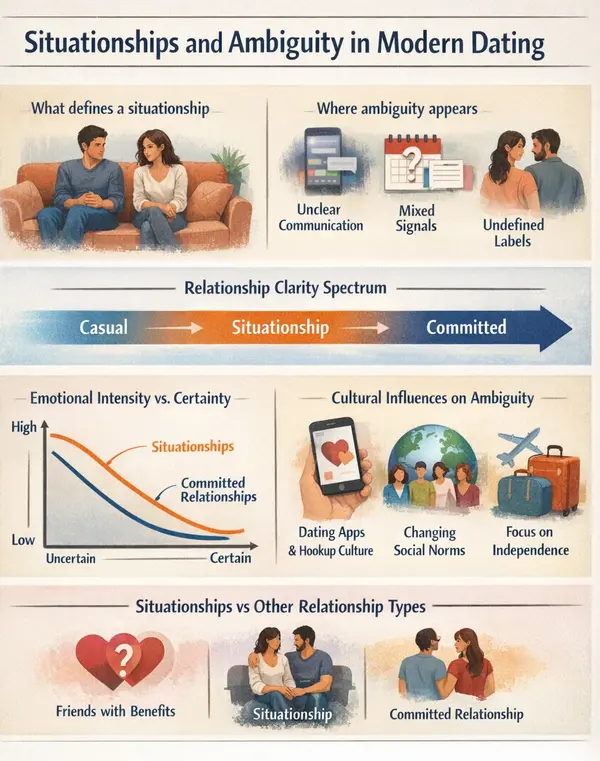
Situationships persist not because people universally prefer ambiguity, but because modern dating environments often reward it.
Several factors contribute:
- Cultural flexibility: Fewer rigid norms mean fewer expectations to define relationships early.
- Personal timing: Individuals may want connection without long-term planning during career changes, relocations, or personal transitions.
- Risk management: Avoiding labels can feel safer than confronting potential mismatch or loss.
Sociological research on commitment avoidance suggests that uncertainty can function as a temporary compromise between desire for connection and fear of limitation. Situationships often exist in this in-between space.
Common Misconceptions About Situationships
Situationships are frequently misunderstood. Some common misconceptions include:
- “They are always unhealthy.”
While some situationships cause distress, others are mutually understood and emotionally manageable. - “They are just casual hookups.”
Many situationships involve emotional intimacy that goes far beyond casual interaction. - “One person is always misleading the other.”
Ambiguity can be co-created, even when it eventually becomes uncomfortable.
Avoiding moral judgments allows for a clearer understanding of why situationships exist and how they function.
Situationships Compared to Other Relationship Forms
Situationships share traits with other relationship types but remain distinct.
- Situationships vs casual dating
Casual dating often involves low emotional investment and clear non-commitment. Situationships may involve deeper emotional bonds without explicit agreement. - Situationships vs committed relationships
Committed relationships typically include mutual recognition, shared expectations, and future orientation. Situationships lack these defining features, even when emotional closeness is present. - Overlap and gray areas
Many relationships move through phases of ambiguity. Not every undefined connection remains a situationship indefinitely.
These comparisons highlight that situationships are not entirely separate from other relationship forms, but rather exist along a spectrum of clarity and commitment.
Broader Implications for Understanding Modern Relationships
Situationships offer insight into broader trends in intimacy and communication. They reflect:
- Shifting expectations around commitment
- Greater tolerance for uncertainty
- Increased emphasis on personal autonomy
From a research perspective, they underscore the importance of communication—not necessarily to eliminate ambiguity, but to understand how it is experienced by those involved.
Ambiguity reshapes how people interpret closeness, loyalty, and emotional safety. Situationships make these dynamics visible in ways more traditional relationship labels often obscure.
Conclusion:
Situationships are best understood not as failures of dating, but as reflections of it. They capture the tension between connection and clarity that characterizes modern romantic life.
By examining how ambiguity functions—structurally, emotionally, and culturally it becomes clear that situationships are neither inherently good nor bad. They are context-dependent arrangements shaped by social change, individual expectations, and evolving norms.
As dating continues to diversify, situationships remain a useful lens for understanding how people navigate intimacy when the path forward is not clearly marked.
References
- American Psychological Association. Uncertainty and decision-making in close relationships. https://www.apa.org
- Lehmiller, J. J. (2020). The psychology of human sexuality (2nd ed.). Wiley. https://www.wiley.com