Valentine’s Day is often treated as a celebration of romance, but emotionally, it functions more like a relationship snapshot. It compresses expectations, symbolism, and cultural messaging into a single day. For some couples, it passes smoothly and pleasantly. For others, it feels charged, revealing tensions that seemed quieter before.
The holiday itself does not determine the health of a relationship. What it does is concentrate attention. And when attention intensifies, patterns become easier to see.
Understanding what Valentine’s Day reveals requires looking beyond flowers, dinners, or gifts. The more meaningful signals lie in expectations, responsiveness, effort, emotional security, and how partners handle difference.
Valentine’s Day as a Relational Snapshot
Daily relationship dynamics often operate on autopilot. Work schedules, routines, and practical responsibilities can overshadow emotional evaluation. Valentine’s Day interrupts that flow. It invites reflection, comparison, and symbolic meaning.
Because of this, the day can act as a magnifier. Small gaps in communication may feel larger. Minor differences in expectations may feel more noticeable. The emotional “temperature” of the relationship becomes easier to sense.
In this way, Valentine’s Day reveals ongoing patterns rather than creating new ones.
Also read: Why Valentine’s Day Brings Out Hidden Relationship Problems
Expectations Beneath the Surface
Every relationship contains expectations some discussed, others assumed. Valentine’s Day often exposes the unspoken ones.
One partner may attach deep emotional meaning to the day, viewing it as confirmation of closeness and priority. The other may see it as optional or culturally overstated. When these internal interpretations are not shared, misalignment becomes visible only when the day arrives.
Disappointment frequently stems from a mismatch in meaning rather than a lack of care. The holiday reveals how well partners understand each other’s expectations and whether those expectations have ever been clearly communicated.
Effort and Perceived Investment
Valentine’s Day often becomes a symbolic test of effort. Planning, initiating, remembering details, or creating intentional moments can be interpreted as signs of emotional investment.
However, effort is subjective. Some people express care consistently through everyday reliability. Others express it through symbolic gestures tied to occasions. When these styles differ, Valentine’s Day highlights the contrast.
What the day reveals is not necessarily how much someone cares, but how aligned partners are in recognizing and valuing each other’s expressions of effort.
Emotional Responsiveness and Attunement
Beyond tangible gestures lies emotional responsiveness. How does each partner respond to the other’s feelings about the day? Is there acknowledgment, curiosity, or validation?
Valentine’s Day can reveal the degree of emotional attunement in a relationship. If one partner expresses excitement, disappointment, or anxiety, the other’s response often reflects deeper relational habits. Responsiveness signals awareness. Dismissiveness or avoidance can indicate emotional distance.
The holiday brings these subtle dynamics into sharper focus.
Security and Reassurance
Symbolic occasions tend to activate questions of security and reassurance. Valentine’s Day may prompt reflection on exclusivity, priority, or emotional closeness.
If the relationship already feels stable, the holiday often reinforces that sense of security. If uncertainty exists about commitment, future direction, or emotional balance the day can amplify those doubts.
The intensity of one’s emotional reaction often reveals underlying confidence or insecurity within the relationship. Strong reactions are rarely about the date alone; they are connected to broader relational context.
Comparison and External Influence
Valentine’s Day is culturally saturated. Social media, advertising, and public displays of affection create a shared narrative of what romance “should” look like.
Comparison becomes almost unavoidable. Even individuals who typically avoid comparison may feel its subtle influence. Observing others’ celebrations can create contrast that highlights satisfaction or dissatisfaction.
What comparison reveals is internal confidence. Relationships grounded in mutual understanding tend to feel less shaken by external narratives. Those already marked by uncertainty may feel more vulnerable to contrast.
Conflict Patterns and Avoidance
When disappointment arises on Valentine’s Day, how it is handled reveals communication patterns.
Some couples address tension directly, discussing expectations and misunderstandings. Others minimize, deflect, or avoid the topic entirely. The chosen response often mirrors how conflict is managed throughout the relationship.
The holiday therefore becomes a microcosm of broader conflict styles. It shows whether disagreements lead to constructive engagement or quiet resentment.
Alignment Versus Misalignment
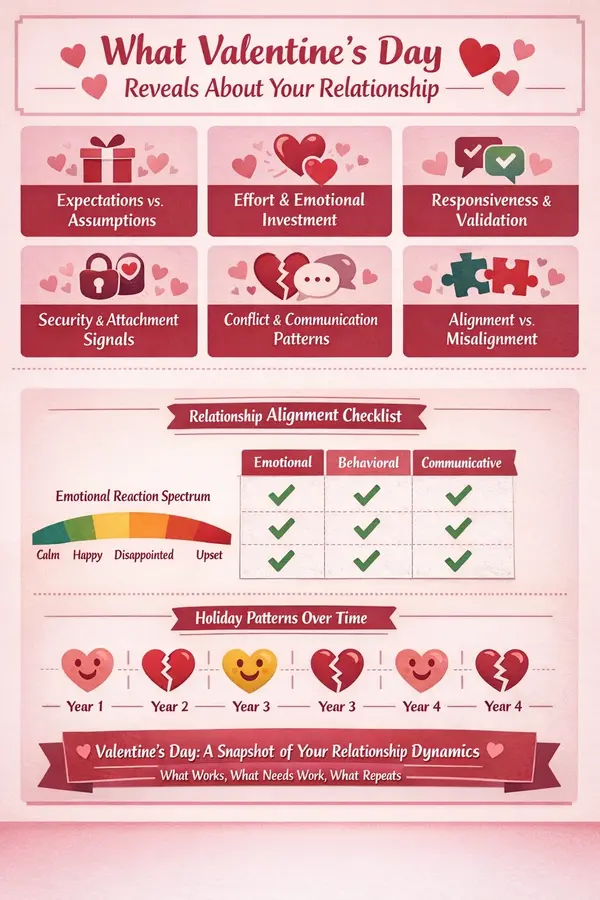
Valentine’s Day also highlights alignment. Emotional alignment appears when both partners attach similar meaning to the day and feel understood in their expectations. Behavioral alignment appears when actions match expressed intentions.
Misalignment, by contrast, shows up as emotional disconnect when one partner feels the day carries weight and the other treats it as insignificant.
Minor misalignments are normal. However, when the same gap appears across multiple occasions or contexts, it may point to deeper incompatibility in values, priorities, or emotional needs.
Repeated Holiday Patterns
One Valentine’s Day rarely defines a relationship. Patterns, however, are informative.
If disappointment, tension, or conflict repeats annually, the issue may extend beyond the holiday. Repeated patterns can indicate ongoing communication gaps, unmet needs, or differing relational expectations.
Conversely, consistent fulfillment across occasions often reflects shared understanding and mutual responsiveness.
Looking at Valentine’s Day as part of a larger pattern provides more insight than focusing on a single moment.
Valentine’s Day as Information, Not Judgment
The most revealing aspect of Valentine’s Day is not whether it is celebrated elaborately or simply. It is how partners interpret and respond to each other during a moment of shared cultural meaning.
The holiday does not issue a verdict on a relationship’s success or failure. Instead, it offers information about alignment, communication, emotional security, and mutual understanding.
When viewed through this lens, Valentine’s Day becomes less about performance and more about awareness. It shows how partners navigate expectation, emotion, and symbolic pressure together.
And often, what it reveals was already there waiting for a moment bright enough to be seen.
Frequently Asked Questions:
1. What does Valentine’s Day reveal about a relationship?
Valentine’s Day often reveals how partners handle expectations, emotional expression, and symbolic meaning. It highlights alignment in effort, responsiveness, and shared understanding.
2. Why do relationship tensions surface on Valentine’s Day?
The holiday concentrates emotional and cultural pressure into a single moment. This heightened focus can make existing communication gaps, unmet expectations, or emotional distance more noticeable.
3. Is disappointment on Valentine’s Day a sign of deeper issues?
Not necessarily. A single disappointment may reflect mismatched expectations. However, repeated dissatisfaction during symbolic occasions can point to broader relational patterns.
4. How does Valentine’s Day highlight communication problems?
Unspoken expectations often surface during high-meaning events. If partners have different assumptions about the day’s importance, it can reveal gaps in communication and emotional clarity.
5. Why do effort and planning feel more significant on Valentine’s Day?
Symbolic occasions tend to amplify gestures. Visible effort may be interpreted as a sign of priority or emotional investment, even if everyday consistency matters more in the long term.
6. Can Valentine’s Day expose insecurity in a relationship?
Yes. Symbolic days can activate questions about reassurance, commitment, and emotional balance. Reactions often reflect underlying levels of security rather than the holiday itself.
7. How does social comparison affect relationships on Valentine’s Day?
Exposure to idealized portrayals of romance can intensify awareness of perceived differences. Comparison often magnifies preexisting doubts rather than creating new dissatisfaction.
8. What does it mean if partners view Valentine’s Day differently?
Differences in how partners interpret the holiday can reveal broader variations in emotional priorities, love languages, or attachment needs. These differences are common but become visible during symbolic moments.
9. Why do small conflicts feel amplified on Valentine’s Day?
Emotionally significant days raise expectations. When reality diverges from those expectations, even minor misalignments can feel more impactful than usual.
10. Is Valentine’s Day a reliable indicator of relationship health?
Valentine’s Day offers insight but not a final judgment. It reflects patterns in effort, alignment, and emotional responsiveness, especially when viewed in the context of repeated experiences over time.