“I’ll never leave you.”
“I promise I’ll always choose you.”
“No matter what happens, I’m here.”
Romantic promises carry a unique emotional intensity. They are often spoken during moments of closeness, conflict, or vulnerability. They feel reassuring, powerful, and deeply meaningful. But beneath the devotion they express, romantic promises and fear of loss are often closely connected—revealing something more subtle: what we are afraid of losing.
Promises are not just commitments to another person. Psychologically, they are attempts to stabilize uncertainty, soothe anxiety, and protect what feels emotionally vital. When examined closely, the words we choose can illuminate our hidden fears as much as our devotion.
Why Promises in Love Feel So Powerful
Promises compress emotion into language. They transform feeling into certainty. In romantic relationships, where vulnerability is high and outcomes are never fully guaranteed, certainty feels especially valuable.
Love inherently involves risk. There is no absolute assurance that affection will remain unchanged, that circumstances will not shift, or that two people will always grow in the same direction. Promises temporarily counter that uncertainty. They offer verbal stability in a dynamic that cannot be fully controlled.
That is why promises feel powerful. They provide psychological grounding in an inherently uncertain emotional landscape.
The Psychology Behind Romantic Promises
From a psychological perspective, promises function as tools for emotional regulation. Research on attachment and commitment suggests that verbal reassurance can reduce relational anxiety by increasing perceived security (Mikulincer & Shaver, Attachment in Adulthood, 2016).
When individuals feel uncertainty after conflict, during distance, or in moments of vulnerability they may instinctively offer strong declarations. These statements are not necessarily manipulative. Often, they are attempts to restore equilibrium.
A promise can serve three psychological purposes:
- Reducing ambiguity
- Reinforcing emotional closeness
- Managing fear of loss
In this sense, promises reveal what feels fragile.
Fear of Abandonment Beneath Devotion
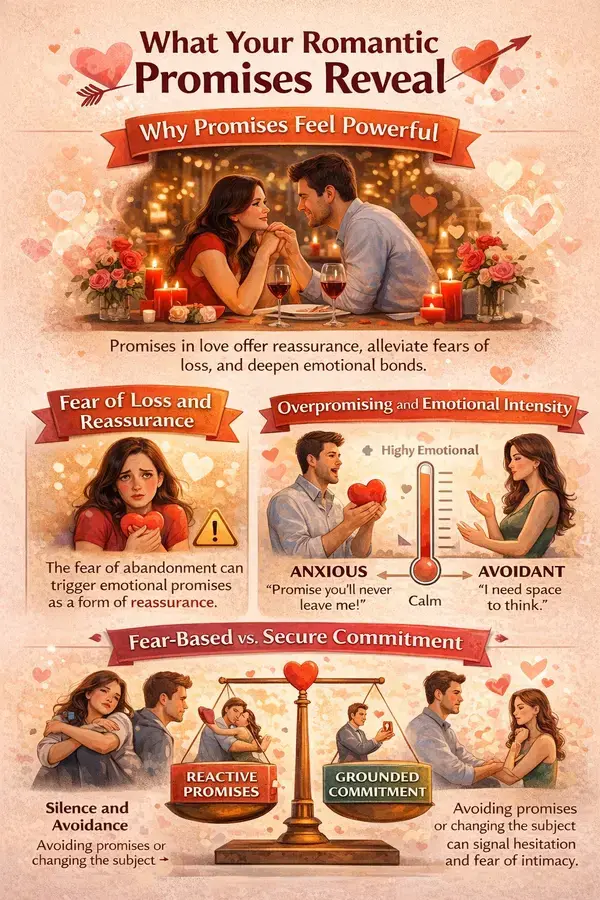
Statements like “I will never leave you” carry deep emotional charge. On the surface, they signal loyalty. Beneath the surface, they may signal fear.
Attachment research consistently shows that individuals with higher attachment anxiety are more sensitive to signs of rejection or distance (Fraley & Roisman, 2019, Current Opinion in Psychology). In moments when closeness feels threatened, reassurance becomes urgent.
The intensity of a promise can reflect the intensity of that fear. The more someone worries about being left, replaced, or deprioritized, the stronger their verbal commitments may become.
This does not diminish the sincerity of the promise. It simply suggests that devotion and fear can coexist.
Promises as Protection Against Uncertainty
Uncertainty is emotionally uncomfortable. Studies on uncertainty reduction in relationships show that ambiguity increases stress and cognitive preoccupation (Knobloch & Solomon, 2002, Human Communication Research).
When a relationship feels undefined or unstable, promises can function as protective anchors. Saying “I’m not going anywhere” may help soothe not only a partner’s anxiety but also one’s own.
In this way, promises sometimes serve as emotional insurance policies. They attempt to guard against imagined loss by verbally strengthening commitment.
But words alone cannot eliminate uncertainty. When promises are used primarily to quiet fear, they may need to be repeated frequently, especially after conflict or tension.
What Overpromising Can Signal
Some relationships begin with rapid, intense declarations: “I’ve never felt this way before,” “You’re my forever,” “I’ll always protect you.”
Early overpromising often reflects heightened emotional activation. Neuroscientific research shows that early romantic love activates reward systems and increases dopamine-related urgency (Acevedo et al., 2012, Social Cognitive and Affective Neuroscience). Intensity can amplify certainty—even when long-term stability has not yet formed.
In certain cases, overpromising may signal an attempt to fast-forward security. When connection feels deeply meaningful but fragile, strong declarations create a sense of permanence that the relationship has not yet had time to establish.
Intensity is not inherently unhealthy. But when promises attempt to replace the gradual building of trust, they can reveal underlying anxiety about losing the connection before it fully stabilizes.
Silence and the Promises Not Made
Fear in love does not always appear as bold declarations. Sometimes it appears as hesitation.
When someone avoids making promises, it may reflect fear of entrapment, loss of independence, or vulnerability. Attachment avoidance research suggests that individuals who value autonomy highly may resist verbal commitments that feel constraining (Mikulincer & Shaver, 2016).
Just as intense promises can signal fear of abandonment, reluctance to promise can signal fear of being consumed or losing autonomy.
Both patterns reveal underlying vulnerability—just expressed differently.
Emotional Triggers That Intensify Promises
Notice when promises tend to appear. Often, they surface:
- After conflict
- During jealousy
- When distance increases
- Following perceived threats to the relationship
Research on relational threat responses indicates that when individuals perceive risk to attachment bonds, they increase behaviors aimed at restoring closeness Overall & Simpson, 2015, Current Opinion in Psychology.
Promises become a way of restoring emotional equilibrium. “I’m here.” “You’re the only one.” “I choose you.” These words attempt to repair perceived fractures.
The stronger the perceived threat, the stronger the reassurance language often becomes.
The Vulnerability Beneath Bold Words
At their core, romantic promises are expressions of vulnerability. They expose what matters most.
When someone promises to “never stop loving,” they reveal how deeply they value being loved in return. When they vow to “always stay,” they reveal how painful departure would be.
Promises often mask the softer truth underneath:
- “I don’t want to lose you.”
- “I’m afraid of this ending.”
- “This connection feels important to me.”
Bold language can be armor for delicate fear.
Recognizing this does not reduce the beauty of promises. It reframes them. Devotion and fear are not opposites; they are intertwined.
Distinguishing Fear-Based Promises from Grounded Commitment
Not all promises are driven by anxiety. Secure commitment tends to feel steady rather than urgent. It is expressed consistently over time rather than primarily in moments of emotional intensity.
Research on secure attachment suggests that individuals with lower attachment anxiety rely less on verbal reassurance and more on predictable, supportive behavior (Fraley, 2019).
Fear-based promises often:
- Appear during emotional spikes
- Feel urgent or absolute
- Require repetition to soothe ongoing insecurity
Grounded commitment tends to:
- Align with behavior
- Feel stable rather than reactive
- Persist without dramatic escalation
The distinction lies not in the words themselves, but in the emotional state driving them.
What Promises Ultimately Reveal
Promises in love are not merely poetic gestures. They are emotional disclosures.
They reveal:
- What feels precious
- What feels fragile
- What feels at risk
When someone says, “I will always choose you,” they are often revealing how deeply they fear not being chosen. When they say, “I’ll never leave,” they may be exposing how much abandonment would wound them.
Love involves both devotion and vulnerability. The promises we make are attempts to bridge the gap between hope and uncertainty.
They are not guarantees of permanence. They are reflections of what matters most.
And often, what we promise to protect most fiercely is exactly what we are most afraid to lose.
Also read: What Valentine’s Day Really Reveals About Your Relationship
Frequently Asked Questions:
1. Why do romantic promises feel so intense?
Romantic promises often emerge during emotionally heightened moments. Because love involves vulnerability and uncertainty, promises create a temporary sense of stability and reassurance.
2. Do strong promises in love always indicate insecurity?
Not necessarily. Promises can reflect sincere commitment. However, when they appear during moments of fear, jealousy, or distance, they may also signal a desire to reduce anxiety about losing the connection.
3. Why do people say “I’ll never leave you” during conflict?
During conflict, perceived emotional threat increases. Reassuring language can function as a way to restore closeness and calm fears of rejection or abandonment.
4. Can overpromising early in a relationship signal something deeper?
Intense declarations early on may reflect strong emotional activation. In some cases, they can also signal a desire to fast-forward security before stability has fully developed.
5. What does hesitation to make promises reveal?
Reluctance to make promises may reflect discomfort with vulnerability, fear of losing independence, or uncertainty about long-term commitment. Silence can reveal fear just as much as bold declarations can.
6. How are attachment styles connected to promise-making?
People with higher attachment anxiety may rely more on verbal reassurance, while those with avoidant tendencies may resist strong verbal commitments. Promise patterns often reflect how individuals regulate emotional security.
7. Why do promises often appear after jealousy or distance?
Moments of perceived threat can intensify reassurance-seeking. Promises may serve as a way to reestablish emotional closeness when the bond feels temporarily unstable.
8. Is there a difference between fear-based promises and secure commitment?
Fear-based promises tend to feel urgent and reactive, often emerging during emotional spikes. Secure commitment is typically steady, consistent, and aligned with long-term behavior rather than momentary intensity.
9. Are romantic promises reliable indicators of long-term stability?
Promises express intention and emotion, but long-term stability depends more on consistent actions, mutual alignment, and sustained emotional responsiveness.
10. What do promises ultimately reveal in a relationship?
Promises often reveal what feels most valuable and most vulnerable. The intensity of a promise can highlight what someone fears losing, even when that fear remains unspoken.