A hug is one of the simplest gestures in a relationship, yet it can carry extraordinary emotional weight. No explanations, no long conversations just two people closing the space between them. And still, not all hugs feel the same. Some feel like relief, like your body finally exhaling after holding tension. Others feel strangely empty you’re being held, but something inside you stays guarded. This is often why some hugs feel safe while others create subtle distance. The difference is rarely about how long the embrace lasts or how tightly someone holds on. It’s about emotional presence. Because a hug is never just physical contact; it is a silent exchange of safety, attention, and connection. And your body often knows the difference before your mind does.
The Emotional Power of a Hug
Human touch carries psychological meaning long before we consciously interpret it. Research in affective neuroscience shows that safe, attuned physical contact can lower stress responses and increase oxytocin the hormone associated with bonding and emotional regulation.
But the body does not respond to touch alone.
It responds to intent and presence.
A hug that feels safe often creates a subtle shift:
- Your breathing slows.
- Your shoulders drop.
- Your body leans in rather than holds back.
You may not analyze it. You simply feel it.
And when that shift doesn’t happen, you feel that too.
Also read: The Promises You Make in Love Often Reveal What You’re Afraid Of Losing
What Makes a Hug Feel Safe
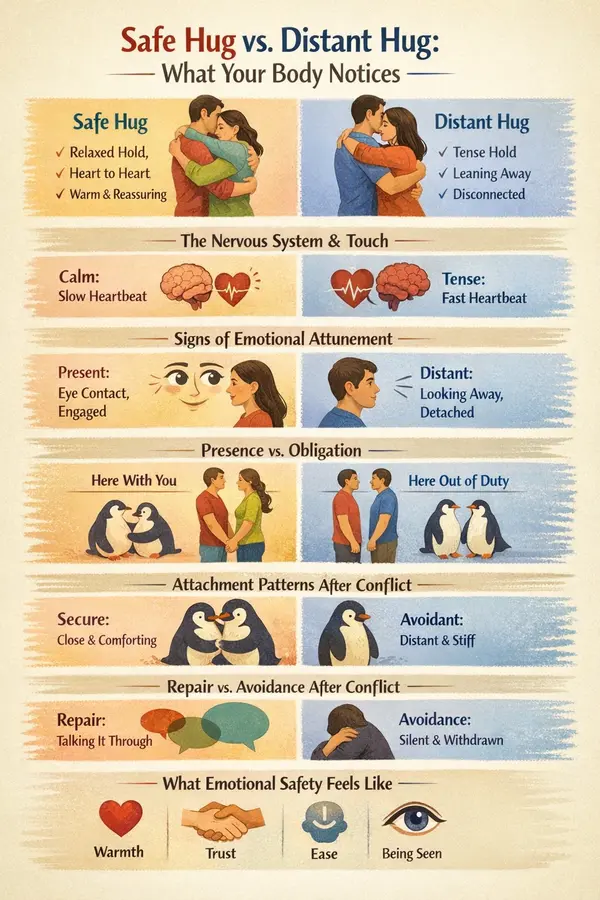
A safe hug is not defined by how long it lasts or how tightly someone holds you. It is defined by emotional attunement.
Attunement means both people are psychologically present in the same moment.
There is mutual awareness. The embrace is responsive rather than automatic. The pressure adjusts naturally. The timing feels unforced. There is no rush to disengage.
The body senses this alignment almost immediately. Studies on interpersonal synchrony show that emotional closeness often creates subtle physiological coordination in breathing patterns, heart rate, and muscle relaxation.
When someone is emotionally available, the hug feels grounding.
It feels like you are being met.
When Physical Closeness Masks Emotional Distance
Now imagine a different scenario.
You reach for someone. They hug you back. But their body feels stiff. Their arms are there, but their attention feels elsewhere. The embrace is brief almost procedural.
Nothing is overtly wrong. But something feels absent.
This is what distance in disguise feels like.
Physical closeness can coexist with emotional disengagement. In fact, sometimes touch is used to avoid a deeper connection. A quick hug can replace a difficult conversation. A light squeeze can signal, “This is enough,” when something unresolved remains underneath.
Instead of reducing loneliness, the gesture intensifies it.
Because the body senses inconsistency.
Read More: The Way Your Partner Hugs You Reveals Their Emotional Availability
Presence vs. Obligation
Not all affection is voluntary in the emotional sense.
Sometimes hugs are given out of habit. Obligation. Social expectation. Or as a way to smooth over discomfort.
Presence feels different from obligation.
When someone is fully present:
- Their weight settles into the embrace.
- Their breathing slows naturally.
- They don’t seem to count the seconds.
When someone is obligated:
- Their body may remain slightly rigid.
- The contact feels partial.
- The release comes quickly.
You might not consciously catalog these details. But your nervous system does.
Attachment Patterns and Touch
Our early relational experiences shape how we experience physical closeness.
Individuals who fear abandonment may cling tightly during moments of insecurity. The hug becomes reassurance a way to prevent emotional distance.
Others who are uncomfortable with vulnerability may offer brief, surface-level contact. The hug is there, but not immersive. It maintains connection without surrendering control.
Neither pattern is inherently wrong. But they create different emotional textures.
A hug that feels safe is not about intensity. It is about regulation. Both people feel steady rather than anxious or guarded.
Safety Is Regulated, Not Declared
Someone can say, “I’m here.”
But if their body feels tense, distracted, or impatient, the message does not land the same way.
Safety is a physiological state. When the nervous system feels secure, muscles soften. Breathing deepens. The body leans in naturally.
Forced reassurance does not create this state. Performance does not create it. It emerges when emotional presence is genuine.
This is why you can be physically close to someone and still feel distant.
The body cannot be convinced by words alone.
Hugs After Conflict
One of the most revealing moments is after an argument.
A hug can feel like repair a signal that emotional connection is intact despite disagreement.
Or it can feel like avoidance a way to bypass unresolved tension without addressing it.
The difference lies in whether the emotional atmosphere has shifted.
If both people have softened, acknowledged each other, and reached mutual understanding, the hug feels warm and stabilizing.
If conflict remains unspoken, the hug may feel like a lid placed on something still simmering underneath.
Your body senses whether repair has truly occurred.
Subtle Signs of Emotional Distance in Physical Closeness
Distance in disguise is rarely dramatic. It is subtle.
It may look like:
- Arms that wrap but do not hold.
- A gentle pat instead of sustained contact.
- One person leaning in while the other leans slightly back.
- Immediate disengagement after initial contact.
Individually, these gestures seem small. But emotionally, they communicate something.
They say, “I’m here but not fully.”
Over time, repeated partial presence can feel lonelier than overt absence.
Why We Notice the Difference Instantly
You rarely need proof to know when a hug feels safe.
The recognition is immediate.
This is because emotional safety is embodied. The nervous system evaluates tone, posture, tension, and micro-movements within seconds. It does not rely on logic.
That’s why someone can hug you in a crowded room and you instantly feel anchored.
And someone else can hug you in private and you still feel exposed.
The contrast sharpens awareness. When you’ve experienced a hug that truly soothes, you can no longer ignore one that doesn’t.
What Safe Connection Actually Feels Like
A safe hug feels steady.
Not dramatic. Not desperate. Not performative.
It feels like:
- Being held without being gripped.
- Being supported without being restrained.
- Being seen without being examined.
There is warmth, but also calm.
There is closeness, but also ease.
Safe connection is quiet. It doesn’t need to prove itself.
And perhaps that is the deepest contrast of all:
The hugs that feel safest are not the tightest or longest.
They are the ones where nothing inside you braces.
Because when someone is truly present, your body does not prepare to protect itself.
It rests.