Kissing often feels like a turning point in early dating. It can intensify attraction, clarify uncertainty, or raise new questions about emotional connection. While words establish intentions, physical gestures frequently communicate subtler signals about comfort, presence, and interest.
In modern dating, where texting, swiping, and digital communication dominate, physical affection can carry amplified meaning. Yet a kiss is not proof of emotional depth, nor is it a reliable predictor of long-term compatibility. Instead, it functions as data: sensory, psychological, and relational information that becomes meaningful when observed over time.
This article explores what kissing styles in early dating may signal about emotional availability, attraction, and intention through the lens of psychology and contemporary relationship research.
Also read: When a Kiss Feels Different: The Hidden Signals Couples Ignore
The Science of Kissing: Sensory and Biological Foundations
Kissing activates multiple neurological and hormonal systems at once. Brain imaging studies show increased activity in areas linked to reward, bonding, and emotional processing during romantic physical contact.
According to research summarized in Archives of Sexual Behavior, kissing stimulates dopamine (associated with reward and desire), oxytocin (associated with bonding), and serotonin fluctuations that can intensify romantic focus (Fisher et al., 2016).
Oxytocin, sometimes referred to as the “bonding hormone,” plays a significant role in attachment formation. A 2018 review in Current Opinion in Psychology noted that physical affection can strengthen pair-bonding mechanisms and increase perceived closeness (Mikulincer & Shaver, 2018).
Kissing also involves smell and taste sensory systems that evolved to assess compatibility. Some evolutionary psychologists suggest that subtle chemical cues may influence perceived attraction, although findings are still debated.
What makes first kisses particularly memorable is this combination of novelty, emotional anticipation, and neurochemical activation. In early dating, where uncertainty is high, a kiss can feel like confirmation—or contradiction of romantic potential.
Also read: The Way Your Partner Hugs You Reveals Their Emotional Availability
Kissing as Nonverbal Communication
Beyond biology, kissing serves as a form of nonverbal communication. Nonverbal behaviors such as proximity, touch, eye contact, and responsiveness often communicate emotional intent more honestly than scripted words.
Psychological research consistently shows that people rely heavily on nonverbal cues to interpret relational meaning. A 2019 review in the Journal of Social and Personal Relationships emphasized that affectionate touch contributes to perceived relational security and emotional attunement.
In early dating, micro-signals during a kiss may include:
- Pace and pressure
- Reciprocity
- Hand placement
- Eye contact before and after
- Emotional presence
The difference between an emotionally present kiss and a performative one often lies in attentiveness. Is the interaction mutual and responsive, or hurried and disconnected?
These cues do not provide certainty, but they can indicate comfort with closeness.
Also read: Why Some Hugs Feel Safe and Others Feel Like Distance in Disguise
Common Kissing Styles in Early Dating and What They May Signal
Interpretations should always be viewed as patterns, not conclusions.
1. The Slow, Attentive Kiss
Description:
Measured pace, mutual responsiveness, natural pauses.
Possible Signals:
- Emotional curiosity
- Comfort with intimacy
- Willingness to slow down and connect
A slow, responsive kiss often reflects emotional presence. It suggests attentiveness to the other person’s reactions and comfort with vulnerability.
2. The Fast, Intense Kiss
Description:
High physical energy, urgency, and strong attraction.
Possible Signals:
- Strong chemistry
- Heightened desire
- Focus on physical intensity
Intensity can reflect attraction, but attraction and emotional availability are not identical. Research in early-stage romantic infatuation shows dopamine-driven excitement may precede emotional stability.
In some cases, intense kissing may indicate emotional enthusiasm. In others, it may primarily reflect physical chemistry.
3. The Hesitant or Brief Kiss
Description:
Minimal pressure, quick withdrawal, cautious pacing.
Possible Signals:
- Nervousness
- Emotional caution
- Uncertainty about compatibility
Early dating often includes vulnerability and evaluation. Hesitation may reflect thoughtfulness rather than disinterest. Context, such as timing, environment, and personality, matters.
4. The Distracted Kiss
Description:
Divided attention, minimal engagement, abrupt transitions.
Possible Signals:
- Emotional distraction
- Limited investment
- Stress unrelated to the relationship
A 2020 study in PLOS ONE found that affectionate touch can buffer stress, but emotional presence is necessary for bonding effects (Packheiser et al., 2020).
If physical affection feels routine or inattentive, it may reflect broader patterns of emotional inconsistency.
5. The Playful, Affectionate Kiss
Description:
Light teasing, laughter, relaxed energy.
Possible Signals:
- Emotional ease
- Growing comfort
- Relational safety
Playfulness is often associated with secure bonding. Research in Personal Relationships (2018) suggests that shared positive affect strengthens early relational stability.
When a kiss integrates warmth and humor, it can indicate comfort rather than performance.
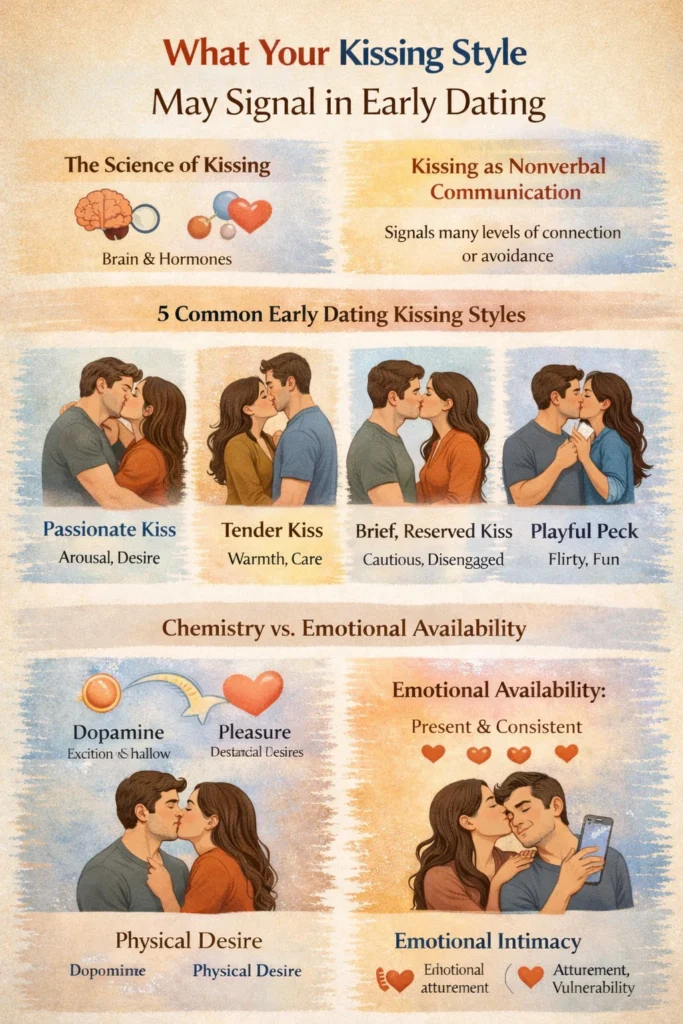
Emotional Availability in the Dating Phase
Emotional availability in early dating includes:
- Consistency in communication
- Follow-through on plans
- Responsiveness to emotional cues
- Willingness to engage in real conversation
A kiss may reinforce these signals or contradict them.
For example:
- Warm, attentive physical affection combined with emotional reliability suggests alignment.
- Intense physical chemistry combined with inconsistent communication may indicate emotional asymmetry.
Physical gestures gain meaning when they match behavioral patterns.
When Kissing Chemistry and Emotional Intent Don’t Align
It is possible to experience:
- Strong physical attraction with limited emotional depth
- Emotional attentiveness with minimal physical chemistry
- Physical intensity without relational clarity
Modern dating culture often accelerates intimacy. Dating apps create rapid escalation, sometimes blurring emotional and physical pacing.
A 2021 review in Computers in Human Behavior noted that digital dating environments can increase perceived intimacy early in interactions, sometimes without a corresponding emotional foundation.
In this context, kissing may feel significant—but emotional intent still requires consistency over time.
Cultural, Personal, and Attachment Influences
Cultural norms strongly shape comfort with public and private affection. Personality traits, upbringing, and attachment tendencies also influence physical expression.
Attachment research consistently shows that:
- Secure individuals are generally comfortable with balanced intimacy.
- Anxious individuals may seek physical reassurance.
- Avoidant individuals may limit prolonged closeness.
These tendencies may subtly influence kissing style, but no single moment defines an attachment orientation.
Patterns Over Time: What Actually Matters
One kiss can be exciting, confusing, or meaningful,l but it rarely provides definitive insight.
More informative indicators include:
- Does physical affection grow more relaxed over time?
- Is there consistency between affection and communication?
- Does emotional depth increase alongside physical closeness?
In early dating, patterns reveal far more than isolated gestures.
The Modern Dating Context
Today’s dating landscape blends digital and physical communication. Texting, social media, and app-based interaction often precede physical closeness.
Because physical time together is limited in early dating, kissing can feel amplified. It may serve as a moment of clarity in an otherwise ambiguous stage.
However, emotional availability is revealed through sustained responsiveness not singular physical intensity.
Conclusion
The way someone kisses you in early dating can provide subtle emotional information. A slow, attentive kiss may reflect presence and curiosity. An intense kiss may signal strong attraction. A hesitant kiss may indicate caution or nervousness.
But a kiss is not a verdict.
It is one piece of relational data most meaningful when considered alongside consistency, communication, and emotional reliability.
In early dating, physical affection may speak, but patterns tell the fuller story.
Frequently Asked Questions (FAQs)
1. Can a kiss in early dating reveal emotional availability?
A kiss can offer subtle clues about comfort with intimacy and emotional presence. However, emotional availability is better assessed through consistent communication, follow-through, and responsiveness over time.
2. What does a slow, attentive kiss usually indicate?
A slow, mutually responsive kiss may reflect emotional curiosity and comfort with closeness. It often suggests attentiveness rather than urgency.
3. Does an intense kiss mean strong feelings?
Intense kissing can signal strong attraction or chemistry. However, physical intensity does not automatically indicate long-term emotional depth or commitment.
4. Why might someone kiss hesitantly in early dating?
Hesitation may reflect nervousness, uncertainty, personality traits, or emotional caution. Early dating often involves evaluation and vulnerability, which can influence physical expression.
5. Is kissing chemistry a reliable sign of compatibility?
Kissing chemistry can indicate physical attraction, but compatibility also depends on communication styles, shared values, emotional regulation, and long-term goals.
6. Can someone be emotionally available but not physically expressive?
Yes. Emotional availability involves responsiveness and consistency, not necessarily frequent or intense physical affection. Some individuals express connection more verbally than physically.
7. Why does a first kiss often feel so memorable?
First kisses combine novelty, anticipation, and heightened neurochemical activity, including dopamine and oxytocin release. These factors can intensify emotional perception.
8. What if kissing feels great but communication feels inconsistent?
Strong physical chemistry paired with inconsistent communication may indicate emotional asymmetry. Observing patterns over time provides more clarity than isolated moments.
9. Do attachment styles influence kissing behavior?
Attachment tendencies can shape comfort with intimacy. Secure individuals often display balanced affection, while anxious or avoidant tendencies may influence intensity or distance.
10. How many dates does it take to understand emotional intent?
There is no fixed timeline. Emotional intent becomes clearer through repeated interactions, consistency, and alignment between words and behavior rather than through a single physical milestone.