Valentine’s Day is often treated as a relationship milestone. In early dating stages, it can feel like a defining moment: Will they plan something? Will they acknowledge the day publicly? Does the effort match the emotional tone of the relationship?
In long-term relationships, the day may carry a different weight, less about impressing and more about continuity, ritual, and meaning. Across relationship stages, Valentine’s Day tends to provoke a similar question:
What does this say about where we’re headed?
While a single holiday cannot predict relational destiny, it can reveal patterns related to emotional alignment, effort investment, communication style, and future orientation. When viewed through a psychological lens, Valentine’s Day becomes less about romance and more about trajectory.
The Role of Symbolic Milestones in Relationship Development
Symbolic milestones, first holidays, anniversaries, and public acknowledgments often feel predictive. Humans naturally assign meaning to events that stand out from routine life.
Why Milestones Feel Predictive
Research in Current Opinion in Psychology (2020) explains that people use salient events to construct relationship narratives. These moments become “data points” in how individuals assess commitment and compatibility (Joel et al., 2020).
Valentine’s Day stands out because it is culturally loaded. Even those who claim not to value it often react emotionally if expectations are misaligned.
The psychological impact comes from its symbolic concentration:
- Cultural expectations
- Social comparison
- Implied romantic meaning
- Visibility
The brain interprets emotionally charged milestones as signals about long-term stability even when that interpretation may exceed the evidence.
Also read: Promise Day Isn’t Romantic, It Exposes the Stability of Your Relationship
Rituals as Compatibility Signals
Relationship research consistently finds that shared rituals strengthen cohesion. A 2019 review in the Journal of Family Theory & Review highlights that rituals promote a sense of shared identity and belonging.
When couples interpret rituals similarly, whether they celebrate elaborately or minimall,y it signals alignment in values and emotional framing. Misalignment, however, can feel amplified because rituals represent shared meaning.
Also read: Valentine’s Day Is Not About Romance It’s a Test of Emotional Alignment
Effort Investment and Future Orientation
Valentine’s Day often reveals how partners approach effort.
Planning vs. Last-Minute Participation
Effort patterns matter more than the scale of the gesture. Research on commitment in the Journal of Personality and Social Psychology (2018) shows that long-term relationship stability correlates with consistent investment behaviors, not isolated romantic intensity (Rusbult et al., 2018 review).
If a partner consistently anticipates meaningful moments and prepares thoughtfully, it may reflect future-oriented thinking. If effort appears reactive or obligatory, that may reflect a different orientation.
This does not predict longevity on its own, but it reveals prioritization patterns.
Consistency vs. Grand Gestures
Large gestures can create emotional highs, but sustainability predicts long-term stability. A 2019 meta-analysis in Psychological Bulletin identified perceived responsivenes,s not grandiosit,y as one of the strongest predictors of long-term satisfaction.
Valentine’s Day can highlight whether affection is episodic or consistent.
Mutual Initiative
Healthy long-term trajectories tend to include reciprocal investment. When only one partner carries the planning or emotional labor, imbalance may emerge.
Valentine’s Day often exposes who initiates shared experiences and whether that pattern is mutual or one-sided.
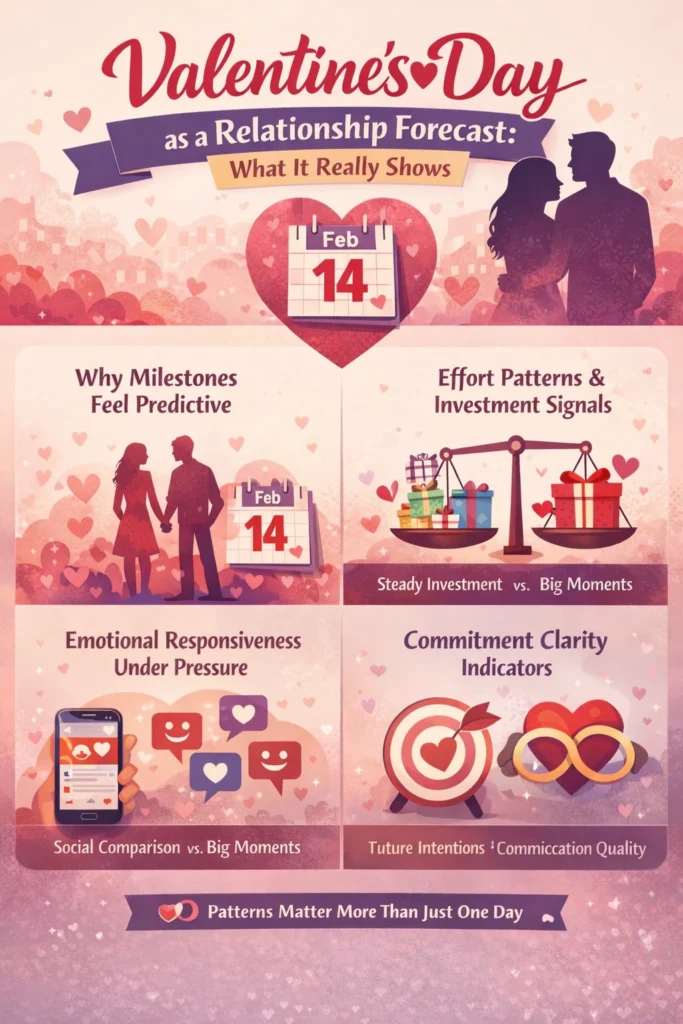
Emotional Responsiveness Under Social Pressure
Symbolic days introduce social comparison.
Handling External Expectations
A 2021 review in Computers in Human Behavior Reports found that romantic social comparison via social media is associated with lower relationship satisfaction when individuals perceive their own relationship as comparatively lacking.
How couples respond to external pressure, whether they compete, withdraw, dismiss, or collaboratively define their own meaning reveals relational maturity.
Responsiveness to Expressed Preferences
Responsiveness is repeatedly identified as a central predictor of relational well-being. Reis & Clark (2022), in Current Opinion in Psychology, describe perceived responsiveness as feeling understood, validated, and cared for.
If preferences are expressed and acknowledged,d even if imperfectly executed that signals emotional attunement. If preferences are dismissed or minimized, it may reveal misalignment in emotional validation.
Regulation of Disappointment
Every couple experiences occasional unmet expectations. What predicts long-term outcomes is not the absence of disappointment but the regulation of it.
Research in Emotion (2019) indicates that autonomy-supportive responses and constructive emotional regulation are linked to higher relational quality.
How partners process disappointment on Valentine’s Day may be more predictive than the disappointment itself.
Alignment in Relationship Definition
Valentine’s Day often brings implicit questions about status and commitment.
Differences in Commitment Framing
In early-stage relationships, ambiguity about exclusivity or seriousness may surface during symbolic events. According to commitment theory research (Stanley & Markman, 2019), clarity about relationship definition is associated with greater long-term stability.
If partners interpret Valentine’s Day differently, one seeing it as a milestone, the other as casual, it may reveal divergence in future orientation.
Exclusivity Signals
Public acknowledgment can feel significant. Whether partners feel comfortable recognizing each other socially can signal alignment in relational seriousness.
However, cultural and personality factors influence public expression, so context matters.
Public vs. Private Recognition
Some couples prioritize private intimacy over public display. Alignment matters more than visibility. When both partners share similar preferences regarding public acknowledgment, friction decreases.
Communication Patterns That Forecast Stability
Communication remains one of the strongest predictors of relational health.
Pre-Event Conversations
Did the couple discuss expectations beforehand? Research in the Journal of Marriage and Family (2020) indicates that open emotional disclosure predicts intimacy and satisfaction.
When expectations are clarified in advance, misinterpretation decreases.
Post-Event Processing
Equally important is how couples reflect afterward. If one partner expresses disappointment, does the other respond defensively or curiously?
Longitudinal studies summarized in Attachment & Human Development (2020) emphasize that responsiveness during emotionally charged conversations predicts long-term relational resilience.
Valentine’s Day often creates a micro-opportunity to observe these patterns.
Conflict Style in Micro-Moments
Micro-conflicts, small disagreements about plans or expectations, can reveal broader patterns:
- Avoidance
- Escalation
- Collaboration
- Emotional withdrawal
What Valentine’s Day Does Not Predict
It is equally important to understand what the holiday does not determine.
Isolated Performance vs. Ongoing Pattern
A single low-effort or awkward celebration does not predict relational failure. Stable relationships are built on patterns, not performances.
Contextual Factors
External stressors financial constraints, work obligations, and health challenges, may shape how the day unfolds. Interpreting the day without context risks overgeneralization.
Projection and Overinterpretation
Humans tend to over-attribute meaning to symbolic events. Attribution theory research suggests that interpreting behavior as reflective of character rather than circumstance can amplify relational dissatisfaction (Bradbury & Fincham, 2018 review).
Valentine’s Day may feel definitive, but it is a snapshot not a verdict.
Using Valentine’s Day as Relational Information
When approached analytically rather than emotionally, the day can provide insight:
- Are effort patterns reciprocal?
- Are expectations discussed or assumed?
- Is disappointment regulated collaboratively?
- Is there shared meaning around rituals?
- Does the relationship feel future-oriented or ambiguous?
These questions point toward broader relational dynamics.
Research consistently identifies three strong predictors of long-term relationship stability:
- Perceived responsiveness
- Consistent investment behaviors
- Constructive conflict management
Valentine’s Day can highlight each of these, but only as one data point among many.
Conclusion
Valentine’s Day does not determine the future of a relationship. It does, however, illuminate patterns.
It can reveal:
- Effort orientation
- Emotional responsiveness
- Communication clarity
- Commitment framing
- Alignment in meaning
The future of a relationship is shaped by repeated behaviors, shared values, and consistent responsiveness over time, not by a single romantic performance.
When viewed through this lens, Valentine’s Day becomes less about romance and more about trajectory. It offers information, not prophecy.
Frequently Asked Questions:
1. Can Valentine’s Day indicate whether a relationship is serious?
Valentine’s Day can highlight how partners define and express commitment, but it does not independently determine seriousness. The way the day is acknowledged publicly, privately, enthusiastically, or minimally may reflect alignment in expectations, yet long-term commitment is shaped by consistent behavior over time.
2. Why do expectations feel higher around Valentine’s Day?
Cultural narratives, marketing, and social media amplify the idea that Valentine’s Day should be meaningful. These external influences can raise expectations, making differences in effort or interpretation more noticeable than on ordinary days.
3. Does a lack of planning signal a lack of future intention?
Not necessarily. Planning style can reflect personality, stress levels, or differences in how symbolic days are valued. It becomes more indicative only when low effort reflects an ongoing pattern of low investment across multiple situations.
4. How can Valentine’s Day reveal emotional alignment?
The holiday often exposes whether partners share similar views about rituals, affection, and celebration. Alignment tends to feel effortless, while mismatched expectations may create tension or disappointment.
5. Why can small disagreements feel amplified on Valentine’s Day?
Symbolic days compress emotional meaning into a short timeframe. When expectations are unclear or assumptions differ, minor issues may carry greater emotional weight than they would in everyday interactions.
6. What matters more than gifts or grand gestures?
Research consistently highlights perceived responsiveness, consistent investment, and constructive communication as stronger indicators of long-term relational health than the size or cost of a celebration.
7. Can Valentine’s Day clarify exclusivity in modern dating?
In early-stage relationships, how partners approach Valentine’s Day can indirectly reflect their comfort with public acknowledgment or exclusivity. However, clarity typically comes from explicit conversations rather than symbolic gestures alone.
8. Why does Valentine’s Day sometimes create doubt about the relationship?
When expectations and experiences diverge, individuals may interpret the gap as a signal about compatibility or future direction. These interpretations often reflect broader concerns rather than the holiday itself.
9. Is Valentine’s Day more important in early-stage relationships?
Valentine’s Day often feels more significant in early-stage relationships because it can surface questions about exclusivity, seriousness, and shared expectations. In newer connections, symbolic events may carry added weight as partners assess long-term compatibility.
10. How can couples interpret Valentine’s Day without overanalyzing it?
Viewing the day as one data point within a broader pattern can help maintain perspective. Relationship trajectories are shaped by consistent responsiveness, shared values, and communication over time not by a single holiday experience.