Emotional expression plays a central role in romantic relationships. It shapes how partners interpret each other’s needs, respond to conflict, build intimacy, and maintain long-term connection. While attraction may initiate a relationship, the ongoing expression of emotion how feelings are communicated, regulated, and received often determines its depth and durability.
Emotional expression is not identical to emotional regulation or self-disclosure. Regulation refers to managing emotional intensity. Disclosure refers to sharing personal information. Expression, by contrast, involves the outward communication of internal emotional states through words, tone, facial expressions, gestures, and timing.
Research across attachment theory, interpersonal psychology, and communication science consistently shows that emotional expression patterns influence relationship satisfaction, perceived responsiveness, and long-term stability. This article examines the psychological mechanisms underlying emotional expression in romantic partnerships and how these patterns shape relational outcomes over time.
What Emotional Expression Means in Adult Romantic Relationships
Emotional expression can be understood across several dimensions:
1. Verbal vs. Nonverbal Expression
- Verbal: naming feelings (“I feel disappointed”)
- Nonverbal: tone shifts, facial expressions, posture, physical touch
Nonverbal cues often carry more emotional weight than spoken content. Research in Emotion Review (Keltner & Cordaro, 2018) highlights how facial and vocal cues significantly influence how emotions are interpreted in close relationships.
2. Direct vs. Indirect Communication
Direct expression involves clearly labeling emotions.
Indirect expression may involve sarcasm, withdrawal, or behavioral cues rather than explicit statements.
3. Frequency, Intensity, and Timing
Emotional expression varies not only in type but in:
- How often emotions are expressed
- The intensity of emotional display
- The timing relative to triggering events
Each of these variables influences how emotions are perceived and responded to within a partnership.
4. Cultural and Personality Influences
Cultural background, family modeling, and personality traits such as extraversion or neuroticism significantly affect expressive norms. What feels transparent in one context may feel overwhelming or insufficient in another.
Also read: The Way Your Partner Hugs You Reveals Their Emotional Availability
The Role of Emotional Expression in Intimacy Development
Emotional expression functions as a primary pathway to intimacy.
When one partner expresses emotion and the other responds with attunement:
- Emotional vulnerability increases
- Psychological safety deepens
- Trust accumulates
Over time, repeated cycles of expression and responsive acknowledgment build relational security.
Importantly, intimacy develops not simply through emotional intensity, but through consistent responsiveness to emotional signals.
Emotional Suppression vs. Emotional Expression
Emotional suppression involves inhibiting outward emotional display despite internal experience.
Short-term, suppression may reduce immediate conflict. Long-term, it can:
- Increase internal stress
- Reduce emotional clarity between partners
- Create misalignment between internal and external states
- Diminish perceived openness
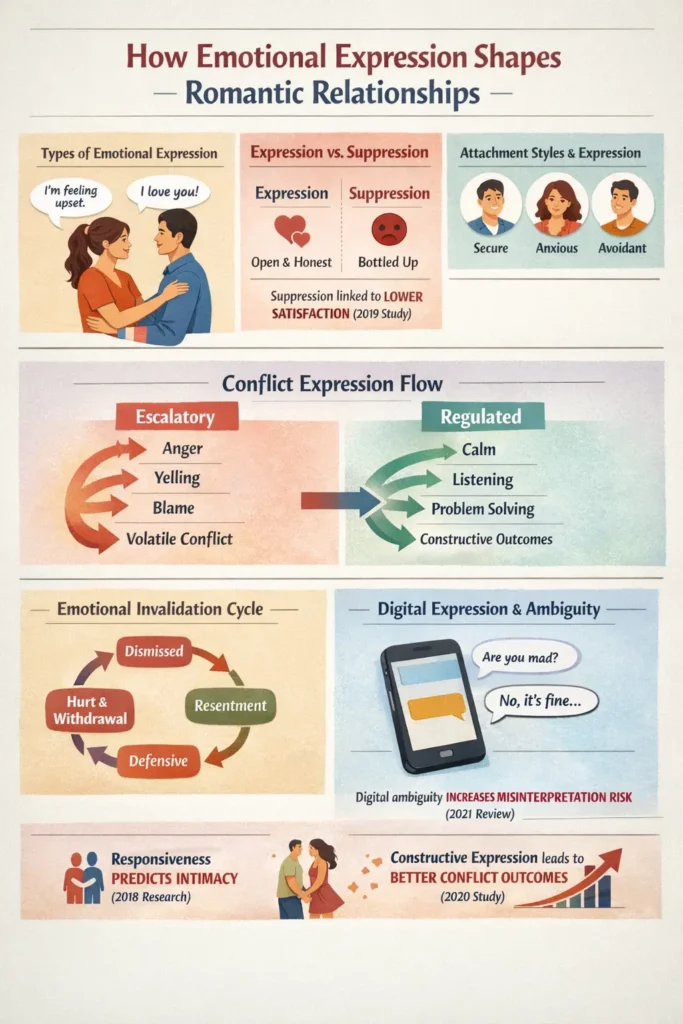
Authentic expression, when regulated constructively, tends to correlate with stronger relational trust and stability.
Attachment Styles and Emotional Expression Patterns
Attachment theory offers a framework for understanding differences in emotional expression.
Secure Attachment
Securely attached individuals typically express emotions directly and regulate intensity effectively. They are more likely to interpret a partner’s emotional signals accurately and respond constructively.
Anxious Attachment
Individuals with anxious attachment often display heightened emotional signaling, especially during perceived threats to closeness. Emotional intensity may function as a proximity-seeking behavior.
Avoidant Attachment
Avoidantly attached individuals may minimize emotional expression, especially vulnerability.
Attachment differences can create cyclical patterns:
- One partner escalates emotional expression
- The other withdraws
- Escalation and withdrawal reinforce each other
Understanding these patterns helps explain why emotional expression often reflects deeper relational models.
Read more: 8 Conversation Patterns That Predict Relationship Longevity
Gender, Socialization, and Emotional Norms
Emotional expression is influenced by social norms.
These social norms can create mismatched expectations:
- One partner may expect verbal emotional articulation
- The other may rely more on behavioral or action-based expression
Misinterpretation of expressive styles can lead to inaccurate conclusions about emotional investment.
Emotional Expression During Conflict
Conflict amplifies emotional expression patterns.
During conflict, emotional expression can take several forms:
- Escalatory (criticism, contempt, raised tone)
- Withdrawn (stonewalling, silence)
- Regulated and specific (naming feelings without attacking character)
Over time, repeated escalatory expression predicts dissatisfaction, while regulated expression predicts resilience.
The Impact of Emotional Invalidation
Emotional invalidation occurs when one partner dismisses, minimizes, or ignores the other’s emotional experience.
Perceived invalidation undermines psychological safety. Research on responsiveness shows that feeling misunderstood is strongly associated with decreased satisfaction and increased relational distress (Reis & Clark, 2018).
Invalidation can create defensive cycles:
- Expression
- Dismissal
- Escalation or withdrawal
- Increased relational tension
Repeated invalidation often shifts emotional expression from vulnerability to defensiveness.
Digital Emotional Expression in Modern Relationships
Modern partnerships increasingly rely on digital communication.
Text-based interaction alters emotional signaling by removing tone, facial expression, and real-time feedback.
Emojis, punctuation, and response timing act as substitutes for nonverbal cues. However, ambiguity can heighten uncertainty about emotional meaning.
In long-distance or digitally mediated relationships, clarity of emotional labeling becomes particularly important due to reduced contextual cues.
Emotional Expression and Long-Term Commitment
Sustained emotional expression contributes to relational resilience across life transitions.
Emotional transparency during major life shifts reinforces:
- Shared identity
- Mutual understanding
- Commitment reinforcement
Long-term relationships often evolve in emotional tone, but ongoing expression supports adaptability.
Common Misconceptions About Emotional Expression
Myth 1: More Emotion Always Means Greater Intimacy
Intensity without regulation can overwhelm partners and reduce perceived safety.
Myth 2: Emotional Control Means Emotional Absence
Regulation involves managing expression, not eliminating emotion.
Myth 3: Emotional Compatibility Removes the Need for Communication
Even emotionally similar partners must continuously interpret and respond to evolving emotional experiences.
Conclusion
Emotional expression in romantic partnerships is not simply about being open or expressive. It involves patterns of signaling, responsiveness, regulation, and perception that develop over time.
Psychological research consistently shows that:
- Expression strengthens intimacy when met with responsiveness
- Suppression predicts relational strain
- Attachment styles shape expressive habits
- Invalidation undermines emotional safety
- Regulated expression during conflict predicts stability
Ultimately, emotional expression functions as a relational feedback system. When partners consistently express and respond to emotions constructively, psychological safety and commitment deepen. When emotional signals are ignored, distorted, or escalated without regulation, relational stability often weakens.
The psychology of emotional expression reveals that intimacy is not created by emotion alone but by the shared understanding that follows it.
Frequently Asked Questions:
1. What is emotional expression in a romantic relationship?
Emotional expression refers to how partners communicate their internal feelings through words, tone, facial expressions, body language, and behavior. It includes both positive emotions (affection, appreciation) and difficult emotions (anger, disappointment, insecurity).
2. Is emotional expression the same as emotional vulnerability?
Not exactly. Emotional vulnerability involves sharing sensitive or personal feelings, while emotional expression is broader and includes everyday emotional signals. Vulnerability is one form of emotional expression, but not all expression requires deep disclosure.
3. How does emotional expression affect intimacy?
Consistent and responsive emotional expression strengthens intimacy by increasing perceived understanding and psychological safety. When partners feel heard and validated, trust and closeness tend to deepen over time.
4. What happens when emotions are suppressed in a relationship?
Habitual emotional suppression can reduce perceived authenticity and clarity between partners. While suppression may prevent immediate conflict, long-term patterns of unexpressed emotion are associated with lower relationship satisfaction and emotional distance.
5. Can too much emotional expression harm a relationship?
High emotional intensity without regulation can overwhelm partners or escalate conflict. Research suggests that balanced, regulated expression rather than constant intensity is more strongly linked to long-term stability.
6. How do attachment styles influence emotional expression?
Attachment styles shape how individuals signal and respond to emotions. Secure attachment is often associated with balanced expression. Anxious attachment may involve heightened emotional signaling, while avoidant attachment may involve restrained or minimized emotional expression.
7. Why does emotional invalidation create relationship strain?
Emotional invalidation dismissing or minimizing a partner’s feelings reduces psychological safety. Repeated invalidation can lead to defensiveness, withdrawal, or escalation, which over time may weaken relational trust.
8. Is emotional expression different in digital communication?
Yes. Digital communication removes many nonverbal cues such as tone and facial expression. As a result, emotions may be misinterpreted more easily in text-based interactions, especially when context or clarification is limited.
9. Do men and women express emotions differently in relationships?
Research suggests that socialization influences emotional norms. Women are often encouraged to express vulnerability more openly, while men may be socialized toward emotional restraint. However, individual differences frequently outweigh gender-based generalizations.
10. Does emotional compatibility guarantee long-term success?
Emotional compatibility can support mutual understanding, but long-term stability is more strongly associated with how partners consistently express, regulate, and respond to each other’s emotions over time.