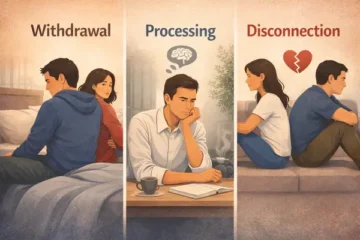
Misunderstandings are inevitable in romantic relationships. Even couples with strong compatibility, shared values, and effective communication skills experience moments of misinterpretation, hurt feelings, or unintended tension. What distinguishes stable relationships from unstable ones is not the absence of conflict but what happens after it.
Repair attempts are the behaviors partners use to de-escalate tension and restore emotional connection following conflict or misunderstanding. Decades of relationship research suggest that the presence, timing, and acceptance of repair attempts are among the strongest predictors of long-term relationship stability.
Understanding the psychology of repair reveals that relational resilience is built not on perfection, but on the ability to reconnect after rupture.
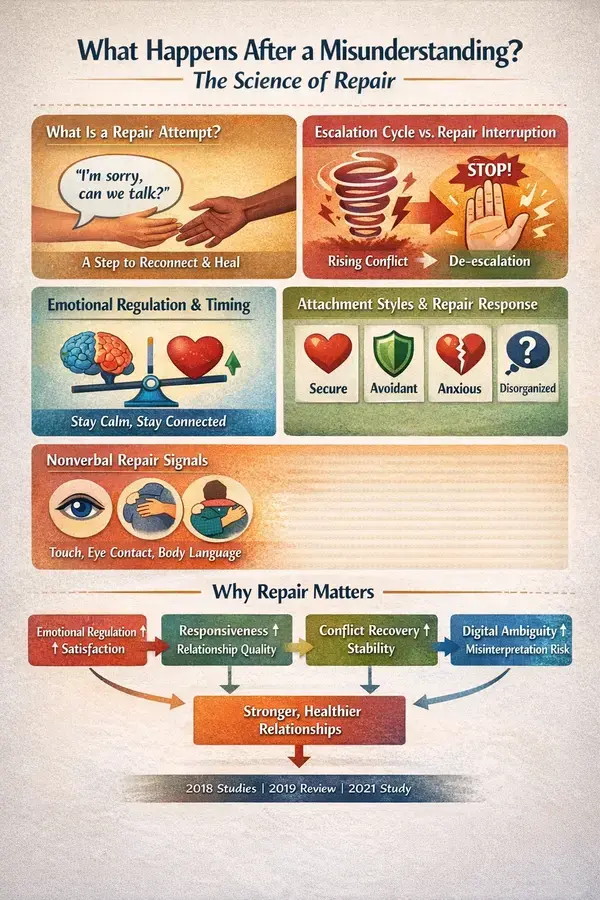
What Is a Repair Attempt?
A repair attempt is any verbal or nonverbal behavior that aims to reduce conflict intensity and reestablish connection.
Repair attempts can be:
1. Verbal
- Acknowledging partial responsibility
- Expressing regret or clarification
- Using humor to soften tension
- Shifting tone toward collaboration
2. Nonverbal
- Softening facial expression
- Gentle physical touch
- Relaxed posture
- Reduced vocal intensity
3. Immediate or Delayed
Some repair attempts occur during conflict escalation. Others occur after a pause when emotional regulation has improved.
The Gottman Institute identifies repair attempts as a key marker separating stable from unstable marriages in longitudinal research ( Importantly, repair attempts are not always dramatic apologies. Many are subtle micro-adjustments in tone or posture that signal willingness to reconnect.
Why Misunderstandings Escalate
Misunderstandings often escalate due to cognitive and physiological processes rather than intentional harm.
Emotional Flooding
When heart rate increases and stress hormones rise, cognitive flexibility decreases. Research in Psychological Science (Bloch, Haase, & Levenson, 2018) shows that emotional regulation capacity strongly predicts marital satisfaction
During flooding:
- Listening accuracy declines
- Defensive interpretations increase
- Tone becomes sharper
Attribution Errors
Partners may assume negative intent during emotionally charged moments, a phenomenon known as negative attribution bias.
Escalation Cycles
One defensive comment can trigger reciprocal defensiveness, creating a feedback loop that intensifies misunderstanding.
Repair attempts interrupt these cycles before they solidify into relational patterns.
Also read: How Emotional Timing Influences Relationship Conversations
The Psychology Behind Effective Repair
Not all repair attempts succeed. Effectiveness depends on several psychological variables.
Emotional Regulation
Repair attempts are more effective when initiated after physiological arousal decreases.
Perceived Partner Responsiveness
Research by Reis and Clark (2018) in Emotion demonstrates that perceived responsiveness feeling understood and cared for predicts relationship satisfaction. Repair attempts signal responsiveness.
Timing
A repair attempt offered during peak escalation may be rejected. When offered during lowered arousal, it is more likely to be accepted.
Tone and Nonverbal Cues
Softened tone and relaxed posture significantly influence whether repair is interpreted as genuine.
Repair is not solely about words; it is about signaling relational safety.
Repair Attempts and the Positive-to-Negative Interaction Ratio
Long-term research on relationship stability emphasizes the balance of positive to negative interactions. The Gottman Institute reports that stable couples maintain approximately a 5:1 ratio of positive to negative interactions during conflict.
Repair attempts increase positive emotional signals even within disagreement. These micro-repairs buffer the impact of criticism or frustration.
For example:
- A brief smile
- A light comment
- Acknowledging shared goals
These signals counteract negative emotional weight and reduce cumulative damage.
Over time, frequent successful repair attempts create emotional resilience.
Acceptance of Repair Attempts
A repair attempt is only effective if it is recognized and accepted.
Research in Current Directions in Psychological Science (Overall & McNulty, 2021) highlights that defensiveness often blocks repair signals.
Repair fails when:
- The receiving partner remains in defensive mode
- The attempt is dismissed as insincere
- Emotional flooding persists
Repair is bidirectional. One partner initiates; the other must reciprocate by lowering defenses.
Successful couples tend to show higher receptivity to repair signals, even during tension.
Attachment Styles and Repair Dynamics
Attachment theory offers insight into how repair attempts are both delivered and received.
Secure Attachment
Secure individuals typically recognize and respond to repair signals constructively. They tend to re-engage more quickly after misunderstandings.
Anxious Attachment
Anxiously attached individuals may seek more explicit reassurance during repair. Subtle attempts may feel insufficient.
Avoidant Attachment
Avoidantly attached individuals may minimize repair attempts or struggle to initiate them, particularly if vulnerability feels threatening.
Repair patterns often mirror attachment tendencies.
Read more: Secure Attachment: Traits, Behaviors, and Relationship Outcomes
Nonverbal Repair Signals
Nonverbal cues can be as powerful as explicit apologies.
Examples include:
- Leaning closer
- Maintaining eye contact
- Soft laughter
- Touching a partner’s hand
Research on nonverbal attunement suggests that coordinated body language and softened vocal tone increase perceived safety and reduce escalation (Keltner & Cordaro, 2018, Emotion Review).
Nonverbal repair often occurs spontaneously and may prevent conflicts from escalating in the first place.
Repair in Digital Communication
Digital communication changes repair dynamics.
Digital repair challenges include:
- Delayed clarification
- Misinterpreted brevity
- Limited emotional nuance
Emojis, punctuation, and explicit emotional labeling often serve as substitutes for nonverbal cues.
Timing also matters in digital contexts; prolonged silence after conflict can amplify misunderstanding.
Long-Term Impact of Repeated Repair Patterns
Repair attempts function as relational maintenance mechanisms.
Repeated successful repair attempts:
- Increase emotional predictability
- Reduce fear of conflict
- Strengthen trust
- Reinforce shared commitment
Conversely, chronic failure to repair can lead to lingering resentment and emotional distance.
Over time, repair becomes part of relational culture.
Common Misconceptions About Repair Attempts
Myth 1: Strong Relationships Don’t Need Repair
All relationships experience misunderstandings. Stability depends on recovery, not absence of rupture.
Myth 2: Apologies Alone Guarantee Resolution
Words without regulation or tone alignment may fail to reduce tension.
Myth 3: Repair Means Conceding Fault
Repair often focuses on reconnecting rather than assigning blame.
Repair reflects prioritization of connection over escalation.
Conclusion
Repair attempts are small but powerful relational behaviors. They interrupt escalation, restore safety, and reinforce commitment after misunderstandings.
The science of repair highlights several key findings:
- Emotional regulation improves repair success
- Perceived responsiveness predicts satisfaction
- Attachment patterns shape repair dynamics
- Nonverbal cues matter as much as words
- Acceptance is as important as initiation
Romantic stability is not defined by conflict avoidance, but by effective recovery. Over time, repeated repair attempts build resilience and emotional trust, transforming inevitable misunderstandings into opportunities for reconnection.
Repair is not a single act it is an ongoing relational process that sustains intimacy across years.
Frequently Asked Questions:
1. What is a repair attempt in a relationship?
A repair attempt is any verbal or nonverbal action intended to reduce tension and restore emotional connection after conflict or misunderstanding. It can include apologies, humor, softened tone, clarification, or physical gestures like a reassuring touch.
2. Why are repair attempts important after misunderstandings?
Repair attempts interrupt escalation cycles and signal willingness to reconnect. Research suggests that how couples recover from conflict predicts long-term stability more strongly than how often they argue.
3. Do repair attempts have to be explicit apologies?
No. While apologies can function as repair attempts, many repairs are subtle. A shift in tone, acknowledgment of shared goals, or light humor during tension can also serve as effective repair signals.
4. Why do some repair attempts fail?
Repair attempts may fail if emotional flooding is still present, if the receiving partner remains defensive, or if the attempt is perceived as insincere. Timing and receptivity significantly influence repair success.
5. How does emotional regulation affect repair attempts?
Emotional regulation reduces physiological arousal, which improves listening, empathy, and flexibility. Repair attempts made after emotional regulation are more likely to be recognized and accepted.
6. Do attachment styles influence how people respond to repair attempts?
Yes. Secure attachment is often associated with greater responsiveness to repair. Anxious attachment may require clearer reassurance, while avoidant attachment may involve difficulty initiating or accepting repair behaviors.
7. Can nonverbal cues act as repair attempts?
Yes. Facial softening, eye contact, relaxed posture, humor, and physical touch can all function as nonverbal repair signals. These cues often communicate intent to reconnect even before words are spoken.
8. How does digital communication affect repair attempts?
Text-based communication lacks tone and facial cues, which can make repair attempts appear neutral or ambiguous. Emojis, explicit clarification, and timely responses often help reduce misinterpretation in digital contexts.
9. Are repair attempts needed in healthy relationships?
Yes. All relationships experience misunderstandings. Healthy relationships are characterized not by the absence of conflict, but by consistent and effective recovery after tension.
10. What happens when repair attempts are repeatedly ignored?
Repeatedly rejected or absent repair attempts can increase resentment, defensiveness, and emotional distance. Over time, this pattern may reduce trust and relational stability.