Trust functions as one of the central psychological pillars of romantic relationships. While love may create emotional intensity and attraction may initiate connection, trust determines whether partners feel secure enough to rely on one another over time. Without trust, even strong emotional bonds can become unstable.
Psychologically, trust refers to the expectation that a partner will act in reliable, predictable, and emotionally safe ways. It involves vulnerability believing that one’s partner will not intentionally harm, deceive, or disregard important needs. Research consistently shows that trust predicts relationship satisfaction, commitment, and long-term stability.
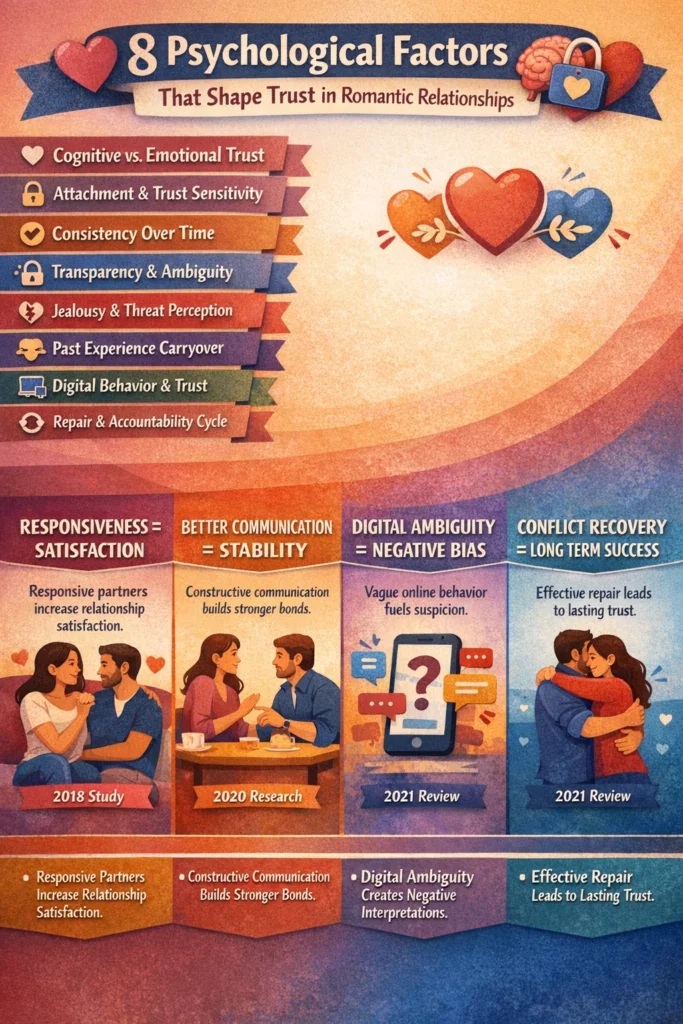
Rather than emerging automatically, trust develops through repeated patterns of behavior, communication, and interpretation. The following eight psychological factors strongly influence how trust forms, stabilizes, or erodes in romantic partnerships.
What Trust Means Psychologically
Trust in romantic relationships has both cognitive and emotional components.
Cognitive Trust
Cognitive trust refers to beliefs about a partner’s reliability and consistency. It answers questions such as:
- Does this person follow through?
- Are their behaviors predictable?
- Do their words align with their actions?
Emotional Trust
Emotional trust involves psychological safety. It reflects:
- Comfort expressing vulnerability
- Confidence that emotions will be respected
- Expectation of responsiveness during stress
Research by Reis and Clark (2018) in Emotion shows that perceived partner responsiveness strongly predicts relationship satisfaction and trust development. When individuals feel understood and validated, trust deepens.
Trust is cumulative. It develops through repeated experiences rather than isolated events.
Factor 1: Attachment Style
Attachment theory provides one of the strongest frameworks for understanding trust dynamics.
Secure Attachment
Securely attached individuals typically approach relationships with baseline trust. They are more likely to interpret ambiguous behavior neutrally and recover more quickly after misunderstandings.
Anxious Attachment
Anxiously attached individuals may experience heightened sensitivity to potential rejection. Research indicates that anxious attachment is associated with hypervigilance toward relational threats (Overall & Simpson, 2019, Current Opinion in Psychology,
Avoidant Attachment
Avoidantly attached individuals may maintain guarded trust. They may rely less on partners emotionally, which can limit deep trust development.
Attachment patterns influence how partners interpret behaviors, especially during ambiguity.
Also read: How Attachment Styles Develop From Childhood to Adulthood
Factor 2: Consistency of Behavior
Consistency is one of the strongest predictors of cognitive trust.
Trust strengthens when:
- Promises are kept
- Actions align with words
- Emotional reactions remain relatively stable
Inconsistent behavior creates uncertainty. Over time, unpredictability increases cognitive strain and weakens trust expectations.
Factor 3: Emotional Transparency
Emotional transparency involves clear communication of intentions, feelings, and motivations.
Transparency does not mean disclosing every thought. Rather, it involves reducing ambiguity around important relational matters.
Ambiguity, by contrast, can trigger:
- Negative interpretation bias
- Suspicion
- Overanalysis of minor behaviors
Emotional transparency stabilizes trust by reducing interpretive gaps.
Factor 4: Communication Patterns During Conflict
Conflict provides a powerful test of trust.
Constructive conflict communication characterized by regulated tone, collaborative framing, and responsiveness reinforces safety. Defensive or contemptuous patterns, however, undermine trust over time.
Repair attempts during conflict also play a central role. Effective recovery after misunderstandings strengthens trust because it signals accountability and commitment to reconnection.
Repeated escalation without repair erodes emotional safety.
Factor 5: Jealousy and Threat Perception
Jealousy is a natural emotional response to perceived relational threats. However, its intensity and interpretation vary significantly.
Psychological research indicates that jealousy often reflects both situational triggers and internal attachment-based vulnerabilities. Anxious attachment, in particular, correlates with heightened jealousy responses.
Cognitive biases—such as confirmation bias can intensify suspicion. Ambiguous situations may be interpreted as evidence of betrayal when trust is already fragile.
Moderate jealousy may signal relational investment, but chronic hypervigilance can destabilize trust by reinforcing threat-focused thinking.
Trust stability depends partly on how partners interpret potential threats.
Factor 6: Past Relationship Experiences
Trust rarely develops in isolation from history.
Previous experiences of betrayal, infidelity, or emotional abandonment can shape expectations in future relationships. Individuals who have experienced past breaches may show increased sensitivity to ambiguity.
Research suggests that carryover effects from prior relationships influence trust formation in new partnerships (Lavner & Bradbury, 2019).
Distinguishing between projection (reacting to past experiences) and present evidence is psychologically complex. Without awareness of this carryover effect, past experiences can amplify suspicion even when current behavior is neutral.
Factor 7: Digital Behavior and Transparency
Modern relationships include digital layers that influence trust.
Social media visibility, messaging frequency, and response timing can all shape perceptions of reliability and transparency.
A 2021 review in Computers in Human Behavior found that digital ambiguity increases negative interpretation bias (Hall et al., 2021).
Digital trust concerns often involve:
- Delayed replies
- Private messaging with others
- Password sharing expectations
- Public vs. private online interactions
Because digital communication lacks nonverbal cues, ambiguity may intensify suspicion.
Digital behavior has become a modern trust variable.
Factor 8: Repair and Accountability After Mistakes
No relationship is free from mistakes. What predicts long-term trust is how partners respond afterward.
Repair behaviors include:
- Acknowledging harm
- Demonstrating accountability
- Showing behavioral change
Research on conflict recovery suggests that the ability to repair after misunderstandings predicts long-term stability more strongly than conflict frequency.
Repeated patterns of avoidance or denial weaken trust. Consistent accountability, however, reinforces emotional safety.
Trust recovery depends on sustained follow-through rather than isolated apologies.
Interaction of Trust Factors Over Time
Trust is dynamic and cumulative.
These eight factors do not operate independently. Instead, they interact:
- Attachment influences interpretation of consistency.
- Communication patterns shape perceptions of transparency.
- Past experiences amplify or soften jealousy responses.
- Repair efforts restore safety after disruption.
Trust strengthens through reinforcing cycles of predictability, responsiveness, and accountability. Conversely, inconsistency, ambiguity, and repeated unaddressed breaches create cycles of suspicion.
Over time, partners develop implicit trust narratives shared understandings of reliability and safety.
Conclusion
Trust in romantic relationships emerges from repeated psychological patterns rather than singular declarations of loyalty.
The eight key factors influencing trust include:
- Attachment style
- Behavioral consistency
- Emotional transparency
- Conflict communication patterns
- Jealousy and threat perception
- Past relational experiences
- Digital behavior and ambiguity
- Repair and accountability
Trust is not static. It evolves through interpretation, responsiveness, and behavioral follow-through. Stable relationships tend to show cumulative patterns of predictability and repair, while unstable relationships often show cycles of inconsistency and defensive interpretation.
Understanding these psychological foundations clarifies that trust is built gradually through everyday interactions that reinforce safety, reliability, and mutual understanding.
Frequently Asked Questions:
1. What does trust mean in a romantic relationship?
Trust refers to the expectation that a partner will act in reliable, predictable, and emotionally safe ways. It includes both cognitive trust (belief in consistency and follow-through) and emotional trust (feeling safe being vulnerable).
2. Can love exist without trust?
Romantic feelings can exist without strong trust, but research suggests that long-term relationship satisfaction and stability are strongly linked to consistent trust development over time.
3. How do attachment styles affect trust?
Attachment styles influence how individuals interpret ambiguity and respond to uncertainty. Secure attachment is generally associated with stable trust expectations, while anxious or avoidant attachment may increase hypervigilance or guardedness.
4. Why is consistency important for building trust?
Repeated alignment between words and actions strengthens predictability. Over time, small, consistent behaviors contribute more to trust formation than occasional grand gestures.
5. How does jealousy relate to trust?
Jealousy often reflects perceived relational threat. Moderate jealousy may signal investment, but chronic or heightened jealousy can weaken trust by reinforcing suspicion and negative interpretation bias.
6. Can past relationship experiences influence current trust levels?
Yes. Previous betrayals or emotional injuries can shape expectations in new relationships, sometimes increasing sensitivity to ambiguity or perceived threats.
7. Does digital behavior affect trust?
Yes. Messaging habits, social media activity, and response timing can influence perceptions of transparency and reliability. Digital ambiguity can increase misinterpretation, especially when trust is already fragile.
8. How do communication patterns during conflict impact trust?
Constructive conflict communication and effective repair attempts reinforce emotional safety. Repeated defensiveness, escalation, or avoidance can gradually erode trust over time.
9. Is trust automatic at the beginning of a relationship?
Early trust often reflects optimism and attraction rather than established reliability. Sustainable trust typically develops gradually through consistent experiences and behavioral predictability.
10. Can trust recover after it has been damaged?
Research suggests that trust can rebuild when there is accountability, consistent behavioral change, and reliable follow-through over time. Recovery depends more on repeated patterns than isolated gestures.