Jealousy is one of the most intense and misunderstood emotions in romantic relationships. It can arise suddenly, feel overwhelming, and shift the emotional tone of a partnership within minutes. Yet jealousy is also a universal human response, rooted in both evolutionary and psychological mechanisms.
It is important to distinguish jealousy from related emotions. Envy involves wanting what someone else has. Possessiveness involves attempts to control or restrict a partner. Jealousy, by contrast, emerges when a valued relationship feels threatened by a real or perceived rival.
Psychologically, jealousy functions as a threat-detection emotion. Whether it strengthens or destabilizes a relationship depends on how it is interpreted, regulated, and expressed. Understanding the emotional triggers and cognitive processes behind jealousy provides insight into its broader impact on trust, satisfaction, and long-term stability.
What Jealousy Is Psychologically
Jealousy involves emotional, cognitive, and behavioral components.
Emotional Component
Common emotional reactions include:
- Anxiety
- Anger
- Fear of loss
- Sadness
- Insecurity
Cognitive Component
Jealousy often activates thoughts such as:
- “I might be replaced.”
- “There is something I lack.”
- “My partner’s loyalty is uncertain.”
Behavioral Component
Jealousy may lead to:
- Reassurance-seeking
- Monitoring behaviors
- Withdrawal
- Confrontation
From an evolutionary perspective, jealousy evolved as a mechanism to protect important bonds. From a social-cognitive perspective, it reflects perceived threats to relational security.
Research in Current Directions in Psychological Science (Pietrzak et al., 2018) describes jealousy as a complex emotional response shaped by both internal vulnerabilities and situational cues.
Jealousy can be situational and short-lived or chronic and recurring.
Common Emotional Triggers of Jealousy
Jealousy rarely appears without a perceived trigger. These triggers vary across individuals and contexts.
1. Perceived Romantic or Sexual Rivalry
The presence or even imagined presence of a rival often activates jealousy.
2. Ambiguity in Partner Behavior
Unclear texting patterns, secrecy, or inconsistent communication may heighten suspicion.
3. Social Comparison
Comparing oneself to others in attractiveness, success, or personality can increase perceived vulnerability.
4. Past Experiences of Betrayal
Previous infidelity or abandonment heightens sensitivity to potential threats.
5. Digital Triggers
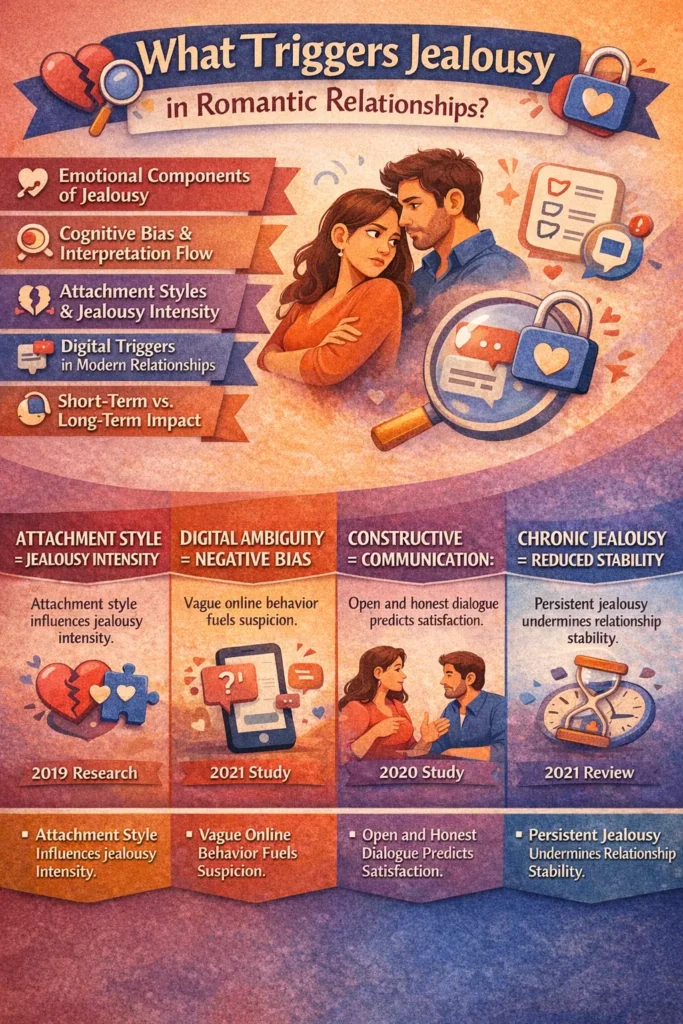
Social media interactions, public comments, or private messaging ambiguity amplify interpretation bias. A 2021 review in Computers in Human Behavior found that digital ambiguity increases negative relational interpretations
Triggers do not automatically determine outcomes. Interpretation plays a central role.
Cognitive Processes Behind Jealousy
Jealousy is heavily influenced by cognitive bias.
Attribution Bias
Individuals may attribute ambiguous behavior to intentional threat rather than neutral causes.
Confirmation Bias
Once suspicion forms, individuals may selectively notice evidence that confirms their fears.
Catastrophic Thinking
Minor incidents can escalate into imagined scenarios of betrayal.
Hypervigilance
Chronic jealousy often includes heightened scanning for signs of threat.
Research in attachment psychology suggests that anxious attachment styles are particularly sensitive to ambiguous relational cues (Overall & Simpson, 2019, Current Opinion in Psychology.
These cognitive processes determine whether jealousy escalates or dissipates.
Also read: 8 Psychological Factors That Influence Trust in Romantic Relationships
Attachment Styles and Jealousy Intensit
Attachment patterns significantly shape jealousy experiences.
Secure Attachment
Secure individuals tend to interpret ambiguous behavior more neutrally and recover from jealousy episodes more quickly.
Anxious Attachment
Anxiously attached individuals often experience heightened jealousy intensity due to fear of abandonment and strong desire for reassurance.
Avoidant Attachment
Avoidantly attached individuals may suppress or minimize jealousy, though internal distress may still be present.
Attachment differences can create cyclical dynamics. For example:
- Anxious jealousy triggers reassurance-seeking.
- Avoidant partners withdraw in response.
- Withdrawal intensifies anxious fear.
Jealousy intensity is often amplified by attachment-based expectations rather than objective threat.
The Role of Self-Esteem and Identity
Self-esteem significantly influences jealousy responses.
Individuals with lower self-esteem may:
- Feel more easily replaceable
- Engage in frequent comparison
- Interpret neutral events as threats
Research in Journal of Personality suggests that self-worth moderates jealousy reactions, particularly in competitive or comparison-based scenarios.
Identity security confidence in one’s value within the relationship—buffers against excessive jealousy.
Jealousy often reflects perceived inadequacy as much as perceived partner behavior.
Behavioral Responses to Jealousy
How jealousy is expressed influences relationship impact.
Reassurance-Seeking
Frequent questioning or requests for validation.
Monitoring Behaviors
Checking devices, social media, or partner whereabouts.
Withdrawal
Emotional distancing or silence.
Escalation
Accusations or conflict initiation.
Research in Journal of Family Psychology (Overall et al., 2020) indicates that defensive or escalatory responses during emotionally charged conversations predict lower long-term satisfaction.
Constructive emotional expression, by contrast, reduces escalation risk.
Behavior not just emotion shapes relational consequences.
Jealousy in the Digital Age
Digital platforms intensify jealousy dynamics.
Features contributing to jealousy include:
- Visible likes and comments
- Follower counts
- Online status indicators
- Delayed responses
Digital interactions lack vocal tone and context, increasing ambiguity. Research shows that ambiguity increases negative interpretation bias, particularly in insecure attachment contexts (Hall et al., 2021).
Modern jealousy frequently involves digital triggers that did not exist in previous generations.
The Impact of Jealousy on Relationship Stability
Jealousy has both short-term and long-term effects.
Short-Term Effects
- Increased attention and reassurance
- Heightened emotional intensity
Long-Term Effects
Chronic jealousy predicts:
- Increased conflict frequency
- Reduced trust
- Emotional exhaustion
Research suggests that repeated jealousy cycles erode relationship satisfaction, especially when paired with defensiveness or avoidance.
Jealousy becomes destabilizing when it shifts from occasional signal to persistent pattern.
When Jealousy Signals Underlying Relationship Issues
Jealousy may reflect deeper relational concerns.
Common underlying factors include:
- Inconsistent partner behavior
- Reduced emotional transparency
- Declining reassurance or connection
- Accumulated unresolved conflict
In some cases, jealousy may signal unmet emotional needs rather than external threat.
Distinguishing between internal insecurity and relational inconsistency is critical for interpretation.
Differentiating Situational Jealousy from Patterned Jealousy
Situational jealousy arises in response to specific events and dissipates once reassurance or clarity is restored.
Patterned jealousy:
- Recurs across contexts
- Persists despite reassurance
- Involves heightened vigilance
Intensity, duration, and frequency differentiate adaptive emotional response from chronic relational strain.
Longitudinal research suggests that recurring jealousy patterns correlate more strongly with dissatisfaction than isolated episodes.
Conclusion
Jealousy is neither inherently destructive nor inherently protective. It is a complex emotional response shaped by:
- Attachment style
- Self-esteem
- Cognitive bias
- Digital context
- Past experiences
Its impact on relationships depends largely on interpretation and behavioral response.
When regulated and expressed constructively, jealousy may prompt clarification and reassurance. When chronic and escalatory, it erodes trust and emotional safety.
Understanding the psychology of jealousy shifts the focus from eliminating the emotion to examining its triggers, cognitive processes, and relational patterns. Over time, it is not the presence of jealousy but its management and interpretation that most strongly influences relationship stability.
Frequently Asked Questions (FAQs)
1. What is jealousy in a romantic relationship?
Jealousy is an emotional response to a perceived threat to a valued relationship. It typically involves fear of loss, insecurity, and concern about a real or imagined rival.
2. Is jealousy normal in relationships?
Yes. Occasional jealousy is a common emotional reaction, especially when a relationship feels important. Its impact depends on intensity, frequency, and how it is expressed.
3. What triggers jealousy most often?
Common triggers include perceived romantic rivals, ambiguous partner behavior, social comparison, past experiences of betrayal, and digital interactions such as social media activity or delayed responses.
4. How do attachment styles influence jealousy?
Attachment styles shape how individuals interpret relational threats. Anxious attachment is often associated with heightened jealousy, while avoidant attachment may involve emotional suppression. Secure attachment tends to involve more regulated responses.
5. Can low self-esteem increase jealousy?
Yes. Lower self-esteem can heighten fears of replaceability and intensify comparison-based thinking, which may increase jealousy reactions.
6. How does social media affect jealousy?
Social media increases visibility and ambiguity in relationships. Likes, comments, and online interactions can be misinterpreted, particularly when trust is already fragile.
7. Does jealousy always harm a relationship?
Not necessarily. Situational jealousy that leads to constructive conversation and reassurance may strengthen connection. Chronic or escalatory jealousy, however, is associated with reduced trust and increased conflict.
8. What is the difference between situational and chronic jealousy?
Situational jealousy arises in response to a specific event and typically subsides after clarification. Chronic jealousy recurs frequently, persists despite reassurance, and may involve ongoing hypervigilance.
9. Can jealousy exist without actual betrayal?
Yes. Jealousy often stems from perceived threat rather than confirmed betrayal. Cognitive biases and attachment insecurities can amplify neutral situations into perceived risks.
10. How does jealousy affect long-term relationship stability?
Repeated, unmanaged jealousy can erode trust, increase conflict frequency, and reduce relationship satisfaction. Over time, persistent jealousy patterns are linked to instability and emotional distance.