Transparency is frequently described as essential for trust in romantic relationships. Yet what transparency means and how much of it is healthy has become increasingly complex in the digital age. Partners now navigate not only emotional openness but also expectations around phones, passwords, location sharing, and social media visibility.
Transparency is not the same as total access. Nor is privacy automatically secrecy. The tension between openness and autonomy sits at the center of many modern trust conflicts.
Psychologically, transparency functions as a clarity mechanism: it reduces ambiguity about intentions, behaviors, and relational commitment. However, when transparency shifts into monitoring or surveillance, it may undermine the very trust it aims to protect.
This article explores how privacy, boundaries, and digital access interact in shaping trust over time.
What Transparency Means Psychologically
Transparency in relationships involves predictable communication and clarity about intentions, behaviors, and commitments.
It includes two primary dimensions:
| Type of Transparency | Description | Example |
|---|---|---|
| Emotional Transparency | Sharing feelings, intentions, and relational concerns | Expressing discomfort about a situation |
| Informational Transparency | Being open about behaviors, plans, or interactions | Clarifying who you’re meeting and why |
Importantly, transparency is most effective when voluntary. Forced disclosure may reduce ambiguity but can increase resentment or defensiveness.
Privacy as a Psychological Need
Privacy is not the opposite of trust. It is a psychological need tied to autonomy and identity.
Healthy differentiation allows individuals to:
- Maintain independent friendships
- Have personal reflections
- Regulate emotions privately
- Develop interests outside the partnership
Privacy becomes problematic when it shifts from autonomy to concealment of relevant relational information. The distinction often lies in intent and pattern rather than isolated behavior.
Also read: The Psychology of Jealousy: Emotional Triggers and Relationship Impact
Boundaries in Romantic Partnerships
Boundaries define acceptable behavior within a relationship. They may be emotional, physical, or digital.
| Boundary Type | Focus Area | Example |
|---|---|---|
| Emotional Boundaries | Depth and type of emotional sharing with others | Avoiding intimate emotional confiding with a third party |
| Physical Boundaries | Physical closeness or touch norms | Agreed limits on physical affection with others |
| Digital Boundaries | Online interactions and access norms | Expectations around messaging transparency |
Boundary mismatches often cause tension. One partner may view certain online interactions as harmless, while the other perceives them as violations.
Clear boundary communication reduces ambiguity and misinterpretation.
Digital Access and Modern Transparency Norms
Digital devices have become central to trust negotiations.
Common digital transparency questions include:
- Should partners share passwords?
- Is location sharing necessary?
- Is private messaging with others acceptable?
- How much social media visibility is appropriate?
Digital transparency expectations vary widely.
| Digital Expectation | Potential Benefit | Potential Risk |
|---|---|---|
| Password sharing | Reduces ambiguity | May shift toward surveillance |
| Location sharing | Increases perceived safety | Can create monitoring cycles |
| Open phone access | Signals openness | May reduce autonomy |
| Social media tagging | Public validation | May create comparison pressure |
Digital access can clarify or intensify trust concerns.
Transparency vs. Surveillance
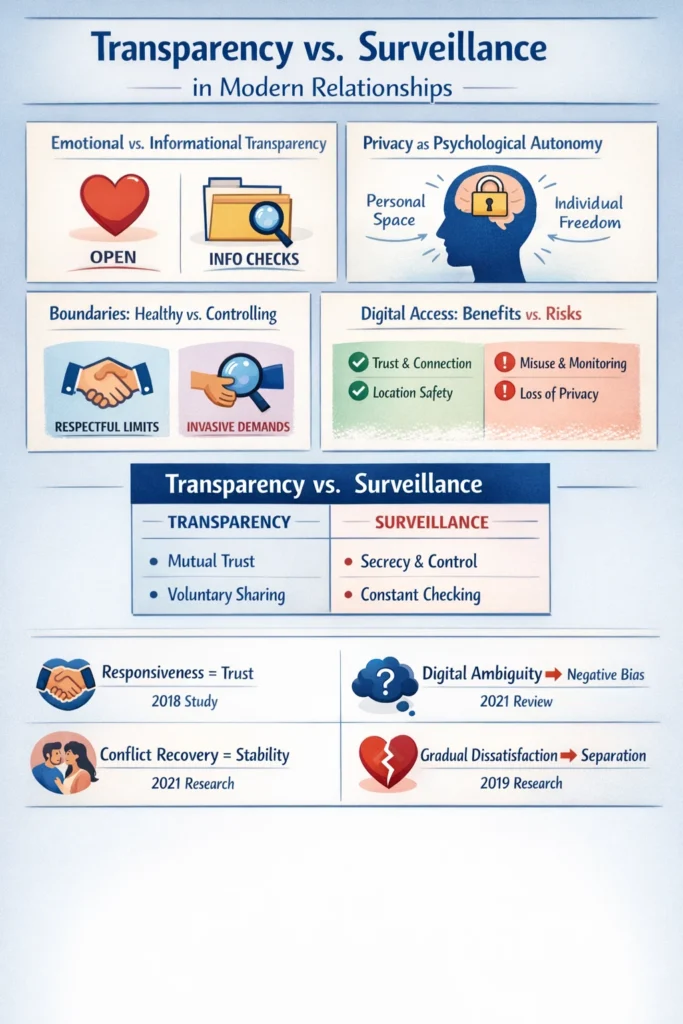
Transparency supports trust when it reduces ambiguity without compromising autonomy. Surveillance, by contrast, attempts to reduce anxiety through monitoring.
The psychological shift occurs when:
- Requests for information become repeated demands
- Reassurance is replaced with checking behaviors
- Monitoring substitutes for communication
| Transparency | Surveillance |
|---|---|
| Voluntary sharing | Demanded access |
| Mutual agreement | One-sided monitoring |
| Focus on clarity | Focus on control |
| Builds trust gradually | May increase insecurity |
When surveillance replaces dialogue, trust can weaken despite increased access.
Attachment Styles and Transparency Expectations
Attachment styles strongly influence transparency norms.
Anxious Attachment
Anxiously attached individuals may prefer higher levels of visibility and reassurance. Ambiguity can feel threatening.
Avoidant Attachment
Avoidantly attached individuals often prefer greater autonomy and may resist increased access expectations.
Secure Attachment
Secure attachment is associated with balanced transparency—clear communication without excessive monitoring.
Research in Current Opinion in Psychology (Overall & Simpson, 2019) highlights how attachment differences shape conflict interpretation and reassurance needs
Transparency conflicts often reflect attachment differences rather than objective wrongdoing.
Know more about this article on Secure Attachment: Traits, Behaviors, and Relationship Outcomes
Ambiguity and Interpretation in Digital Communication
Digital communication lacks tone, facial expression, and contextual nuance.
Ambiguity arises through:
- Delayed responses
- Brief replies
- Selective disclosure
- Visible online interactions without explanation
Cognitive biases can amplify interpretation. When trust is fragile, neutral digital behavior may be interpreted as intentional concealment.
Reducing ambiguity often requires explicit clarification rather than assumption.
When Transparency Strengthens Trust
Transparency strengthens trust when it includes:
- Consistent alignment between words and actions
- Voluntary sharing of relevant information
- Emotional responsiveness during uncertainty
- Willingness to clarify ambiguous situations
Trust deepens when transparency reinforces predictability and emotional safety.
Repeated positive patterns create stable relational narratives.
When Transparency Demands Signal Underlying Insecurity
Excessive transparency demands may indicate deeper insecurity or fear of betrayal.
Warning signs include:
- Repeated requests for proof
- Escalating access expectations
- Monitoring disguised as reassurance
- Increased anxiety despite access
In such cases, access does not eliminate insecurity because the underlying concern is interpretive rather than informational.
Transparency alone cannot resolve chronic suspicion.
Cultural and Social Influences on Transparency Norms
Transparency expectations vary across cultures and generations.
Factors influencing norms include:
- Cultural attitudes toward autonomy
- Family modeling of boundaries
- Generational differences in digital openness
- Social media visibility expectations
In some contexts, full digital access signals commitment. In others, autonomy is prioritized.
Understanding these influences reduces misinterpretation rooted in differing norms.
Conclusion
Transparency in relationships exists on a spectrum between openness and surveillance. While clarity reduces ambiguity and supports trust, excessive monitoring can undermine autonomy and increase insecurity.
Key dynamics include:
- Emotional and informational transparency
- Privacy as a psychological need
- Clear boundary communication
- Digital ambiguity and interpretation bias
- Attachment-based transparency expectations
Trust is strengthened not by total access, but by consistent predictability, voluntary openness, and responsive communication. In modern relationships, transparency must coexist with autonomy to sustain long-term stability.
Frequently Asked Questions
1. What does transparency mean in a romantic relationship?
Transparency refers to clear and predictable communication about intentions, behaviors, and relevant interactions. It involves reducing ambiguity without eliminating personal autonomy.
2. Is privacy the same as secrecy?
No. Privacy involves maintaining personal space and individual autonomy. Secrecy typically involves intentionally concealing information that may affect the relationship. The difference often lies in intent and pattern.
3. Should partners share passwords to build trust?
Password sharing can reduce ambiguity for some couples, but research suggests that trust is built more reliably through consistent behavior and responsiveness than through constant access.
4. How does digital access affect trust?
Digital access can clarify misunderstandings, but excessive monitoring may increase anxiety and reduce autonomy. The impact depends on whether access is voluntary and mutually agreed upon.
5. Can too much transparency harm a relationship?
Excessive transparency demands can shift into surveillance, which may undermine trust by increasing control and reducing psychological safety.
6. How do attachment styles influence transparency expectations?
Anxiously attached individuals may prefer higher visibility and reassurance. Avoidantly attached individuals may prioritize autonomy. Secure attachment is typically associated with balanced openness and clear communication.
7. Why does social media create transparency conflicts?
Social media increases visibility and ambiguity at the same time. Likes, comments, and messaging patterns can be misinterpreted without context, especially when trust is already fragile.
8. What are digital boundaries in a relationship?
Digital boundaries refer to agreed-upon expectations around online interactions, messaging behavior, social media engagement, and device access.
9. Does transparency eliminate jealousy?
Transparency can reduce ambiguity, but jealousy is also influenced by attachment patterns, self-esteem, and cognitive biases. Access alone does not resolve underlying insecurity.
10. How can couples balance transparency and autonomy?
Balance typically involves voluntary sharing, clear boundary discussions, and consistent behavior over time. Trust tends to grow when openness and independence coexist rather than compete.