Anxious attachment style is one of the most common and most misunderstood attachment patterns in adult relationships. People with this attachment style often experience deep emotional investment, heightened sensitivity to changes in closeness, and an ongoing fear of abandonment that can shape how they think, feel, and behave with partners.
This article explains what anxious attachment style is, where it comes from, how it affects relationships, and crucially how it can change. If you’re new to attachment theory, this builds on the basics of what attachment styles are and shows how anxious attachment fits into that framework.
What Is Anxious Attachment?
Anxious attachment style (sometimes called anxious-preoccupied attachment) is characterized by a strong desire for emotional closeness paired with persistent worry about a partner’s availability, commitment, or love.
People with anxious attachment often:
- Value relationships highly
- Feel emotionally attuned to partners
- Experience distress when closeness feels uncertain
The challenge isn’t wanting connection it’s how the nervous system responds when that connection feels threatened.

Attachment theory was originally developed by John Bowlby and later expanded to adult relationships by researchers such as Cindy Hazan and Phillip Shaver. Modern research consistently shows that attachment styles influence emotional regulation, communication, and relationship satisfaction across the lifespan.
Common Signs of Anxious Attachment
Anxious attachment shows up across emotional, behavioral, and cognitive levels. Not everyone experiences all signs, but recognizable patterns tend to repeat.
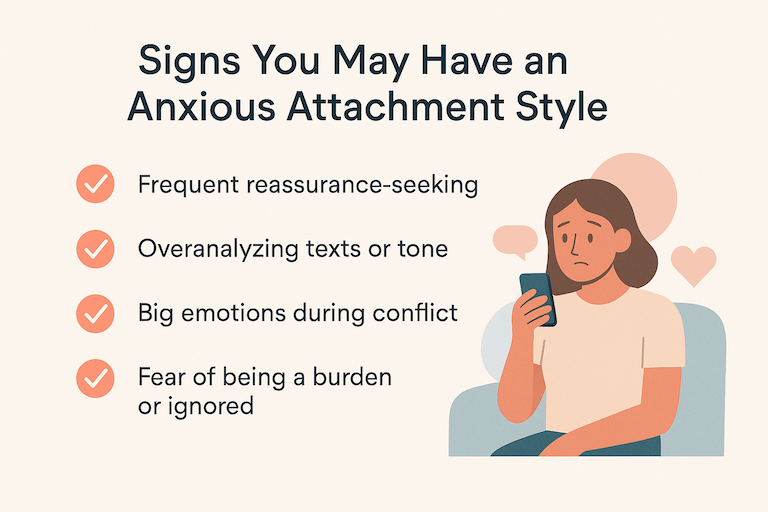
Emotional Signs
- Intense fear of abandonment or being replaced
- Strong emotional reactions to perceived distance
- Feeling “too much” or “not enough” at the same time
Behavioral Signs
- Frequent reassurance seeking “Are we okay?”
- Difficulty tolerating delayed responses to texts or calls
- Over giving, overaccommodating, or self sacrificing to keep closeness
Cognitive Patterns
- Overanalyzing tone, timing, or wording
- Catastrophic thinking when a partner pulls back
- Persistent self doubt about worthiness of love
Research shows that anxiously attached individuals are more likely to engage in hyperactivating strategies: efforts to regain closeness when they feel insecure Mikulincer & Shaver, 2019
What Causes Anxious Attachment?
Anxious attachment develops as an adaptive response to early relational environments not as a flaw or disorder.
Early Childhood Influences
The most common root is inconsistent caregiving:
- Care that is sometimes nurturing, sometimes unavailable
- Emotional responses that are unpredictable
- Love that feels conditional or unstable
Children in these environments learn that closeness is possible but not guaranteed leading to heightened vigilance around connection.
Family and Emotional Environment
- Parents who were loving but overwhelmed
- Emotional unpredictability, illness, or stress in caregivers
- Being rewarded for emotional intensity rather than emotional safety
Later Life Reinforcements
Even if childhood was relatively stable, anxious attachment can be reinforced by:
- Repeated abandonment or betrayal in adult relationships
- Long term relationships with emotionally unavailable partners
- Situationships with unclear commitment
Attachment styles are shaped over time, not frozen in childhood (Fraley, 2019).
How Anxious Attachment Shows Up in Relationships
Anxious attachment affects different stages of relationships in distinct ways.
Dating and Early Relationships
- Rapid emotional bonding
- Desire for frequent communication
- Anxiety when labels or expectations feel unclear
Long Term Partnerships
- Strong investment in the relationship’s emotional health
- Heightened sensitivity to shifts in intimacy
- Tendency to prioritize the relationship over personal needs
Conflict Situations
During conflict, anxious attachment often activates:
- Urgency to resolve immediately
- Difficulty tolerating emotional distance
- Escalation when reassurance is delayed
These reactions are driven by nervous system threat not manipulation or neediness.
Anxious Attachment Relationship Patterns
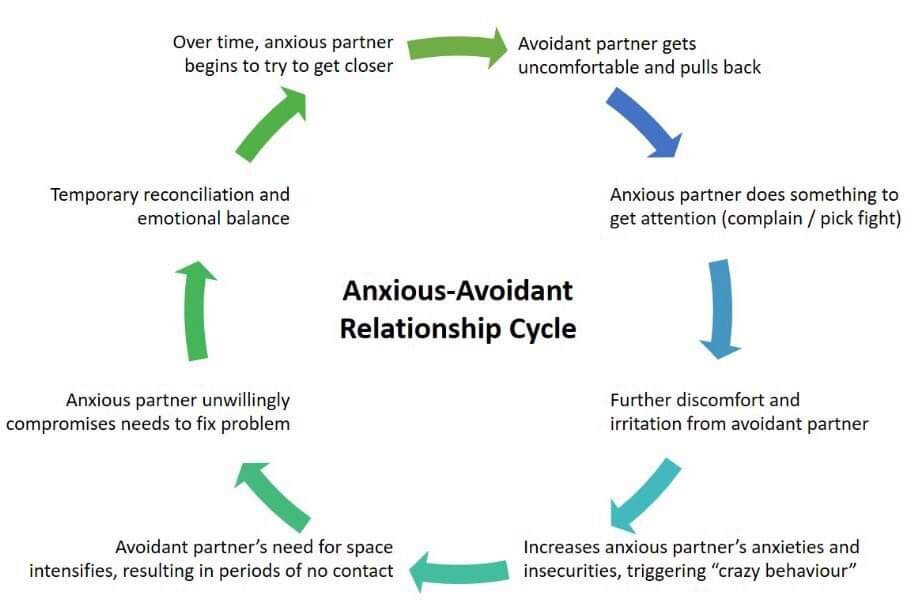
Over time, anxious attachment can create predictable relational cycles.
Push Pull Dynamics
Attempts to get closer may feel overwhelming to partners, leading them to pull away—reinforcing abandonment fears.
Overfunctioning
The anxiously attached partner may:
- Take responsibility for emotional repair
- Monitor the relationship’s “temperature”
- Suppress their own needs to maintain closeness
Emotional Dependency vs. Intimacy
Closeness can become driven by anxiety relief rather than mutual connection.
These patterns are especially intense in anxious–avoidant relationship dynamics, where opposing attachment strategies continuously trigger each other.
Emotional Impact on the Anxiously Attached Partner
Living with anxious attachment can be exhausting.
Common internal experiences include:
- Chronic relational anxiety
- Rumination and mental replaying
- Shame about emotional needs
- Confusion between intuition and fear
Impact on Partners and the Relationship
Partners may experience:
- Pressure to provide constant reassurance
- Misinterpretation of anxious behaviors as control or mistrust
- Cycles of closeness followed by withdrawal
Importantly, most partners do not intend to trigger anxiety but mismatched regulation styles can slowly erode relationship satisfaction if unaddressed.
Can Anxious Attachment Change?
Yes. Attachment styles are adaptive and flexible, not permanent traits.
Longitudinal research shows that attachment security can increase through:
- Emotionally responsive relationships
- Therapy and self reflection
- Repeated experiences of safe repair
Secure attachment is not about never feeling anxious: it’s about trusting that connection can survive distress.
Also read: What Attachment Styles Are and How They Shape Adult Relationships
Healthy Coping Strategies for Anxious Attachment
1. Nervous System Regulation
- Pause before seeking reassurance
- Grounding techniques (breathing, movement)
- Naming emotions without acting immediately
2. Building Internal Security
- Developing self soothing skills
- Expanding identity beyond the relationship
- Strengthening self trust
3. Clear, Non Escalating Communication
- Express needs without urgency or blame
- Ask directly rather than hinting
- Tolerate temporary discomfort
4. Choosing Supportive Dynamics
Partners who are:
- Emotionally responsive
- Consistent in communication
- Willing to engage in repair
can significantly reduce anxious activation over time.
Therapy and Support Options
Attachment focused therapy can be highly effective.
Common approaches include:
- Emotionally Focused Therapy (EFT)
- Attachment based psychodynamic therapy
- Somatic and trauma informed modalities
The American Psychological Association notes that therapy can help individuals develop more secure internal working models of relationships, even after long standing patterns (APA, 2023).
Anxious Attachment vs. Normal Relationship Anxiety
| Aspect | Normal Relationship Anxiety | Anxious Attachment |
|---|---|---|
| When it appears | During early dating, major life transitions, or after a breach of trust | Appears across most or all relationships, regardless of situation |
| Trigger type | Specific, understandable events or uncertainty | Often triggered by small cues or imagined distance |
| Duration | Temporary and settles as clarity or safety increases | Ongoing and persistent over time |
| Response to reassurance | Reassurance usually calms the anxiety | Reassurance brings only short term relief |
| Thought pattern | “I feel unsure because this is new or changing” | “Something is wrong, even when things seem okay” |
| Sense of safety | Anxiety decreases when trust or stability returns | Fear outweighs evidence of safety |
| Relationship impact | Minimal once the situation resolves | Can create cycles of overthinking, reassurance seeking, and emotional exhaustion |
| Key indicator | Context based and situational | Pattern based and repetitive |
Conclusion
Anxious attachment style reflects a deep capacity for connection paired with a nervous system trained to expect loss. Understanding its signs, causes, and relationship patterns is not about self criticism—it’s about clarity.
With awareness, support, and emotionally safe relationships, anxious attachment can soften into security. The goal isn’t to eliminate the need for closeness but to experience it without fear.
Frequently Asked Questions
1. What is anxious attachment style in relationships?
Anxious attachment style is a relationship pattern where a person strongly wants closeness but often worries about being abandoned, ignored, or not loved enough.
2. What are the main signs of anxious attachment?
Common signs include fear of abandonment, overthinking texts or tone, needing frequent reassurance, and feeling anxious when a partner pulls back emotionally.
3. What causes anxious attachment style?
Anxious attachment usually develops from inconsistent emotional care in childhood or from repeated unstable or emotionally unavailable relationships in adulthood.
4. Can anxious attachment develop later in life?
Yes. Even people with secure attachment can develop anxious attachment after breakups, betrayal, cheating, or long term emotional neglect in relationships.
5. How does anxious attachment affect romantic relationships?
It can lead to overthinking, reassurance seeking, emotional exhaustion, and push pull relationship patterns, especially with avoidant partners.
6. Is anxious attachment the same as being needy?
No. Anxious attachment is a nervous system response to fear of losing connection, not a personality flaw or lack of independence.
7. Can anxious attachment be healed or changed?
Yes. Anxious attachment can improve with self awareness, emotional regulation, healthy communication, therapy, and consistent, emotionally safe relationships.
8. What is the difference between anxious attachment and normal relationship anxiety?
Normal relationship anxiety is temporary and situation based. Anxious attachment is ongoing and appears across most relationships, even when things seem stable.
9. Is anxious attachment linked to anxiety disorders?
Not always. Anxious attachment is a relationship pattern, not a mental health disorder, though it can increase stress and emotional overwhelm in relationships.
10. What kind of partner is best for someone with anxious attachment?
Emotionally consistent, responsive, and communicative partners help reduce anxious attachment triggers and support movement toward secure attachment.