Attachment styles help explain why people relate the way they do why some feel secure with closeness, others fear abandonment, and some struggle with emotional intimacy. These patterns do not appear randomly in adulthood. They develop gradually, shaped by early experiences and later relationships across the lifespan.
Understanding how attachment styles develop from childhood to adulthood reframes relationship struggles as learned adaptations rather than personal flaws. Attachment is not a fixed trait decided in infancy; it is a dynamic system that evolves in response to safety, stress, and emotional connection over time.
This developmental perspective is especially important because it highlights two truths at once: early experiences matter, and change remains possible.
Foundations of Attachment Theory
Attachment theory emerged from the work of John Bowlby, who proposed that humans are biologically wired to seek closeness to protective caregivers during times of distress. This attachment system is a survival mechanism, designed to keep infants safe and emotionally regulated.
Bowlby emphasized that children are not just forming bonds they are forming expectations. Based on repeated interactions with caregivers, children learn whether others are reliable and whether they themselves are worthy of care.
Psychologist Mary Ainsworth later expanded this work through observational studies, most famously the Strange Situation. Her research identified distinct attachment patterns based on how infants responded to separation and reunion with caregivers, laying the foundation for what we now recognize as secure and insecure attachment styles.
Together, this research established attachment as:
- A biological system
- Shaped by relational experience
- Central to emotional regulation and relationship behavior
Attachment in Infancy and Early Childhood
Attachment development begins in infancy through everyday interactions with primary caregivers. Feeding, soothing, eye contact, play, and responses to distress all contribute to how the attachment system organizes itself.
Three caregiving qualities are especially influential:
- Consistency: Are responses predictable over time?
- Responsiveness: Are emotional signals noticed and addressed?
- Emotional availability: Is comfort offered in moments of distress?
When caregivers respond in generally consistent and attuned ways, infants learn that:
- Distress can be soothed
- Closeness is safe
- Exploration is possible because support is available
This creates what attachment theory calls a secure base the foundation for both emotional regulation and healthy independence.
Importantly, no caregiver is perfectly responsive. Secure attachment develops from good enough caregiving, not perfection.
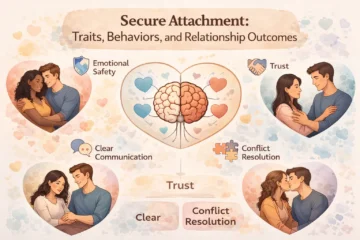
Also read: Secure Attachment: Traits, Behaviors, and Relationship Outcomes
The Formation of Internal Working Models
As children grow, repeated attachment experiences are organized into internal working models—mental templates that guide expectations in relationships.
These models answer core questions such as:
- Can I rely on others when I’m vulnerable?
- Will my needs be met or ignored?
- Am I lovable and worthy of care?
Internal working models operate largely outside conscious awareness. They influence how people interpret tone, distance, conflict, and reassurance later in life. Over time, these models become self-reinforcing: expectations shape behavior, and behavior shapes relational outcomes.
While early childhood plays a major role in forming these models, they remain open to revision through new relational experiences.
How Insecure Attachment Patterns Develop
Anxious Attachment Development
Anxious attachment often develops in caregiving environments that are inconsistent or unpredictable. Care may be warm at times and unavailable at others, leaving the child uncertain about when support will appear.
As a result:
- The attachment system becomes hyperactivated
- The child learns to amplify distress to gain attention
- Fear of abandonment becomes central
This pattern teaches the nervous system that closeness is unreliable and must be actively maintained through vigilance.
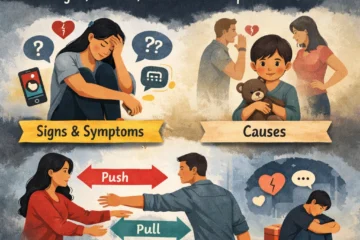
Also read: What Are Attachment Styles? A Psychology-Based Explanation
Avoidant Attachment Development
Avoidant attachment tends to form when caregivers are emotionally unavailable, dismissive, or uncomfortable with dependency. Emotional needs may be minimized, ignored, or subtly discouraged.
In response:
- The child suppresses attachment needs
- Self-reliance becomes a primary coping strategy
- Emotional distance feels safer than closeness
Avoidant attachment is not a lack of attachment—it is a learned strategy for staying connected without risking rejection.
Disorganized Attachment Development
Disorganized attachment develops when caregivers are a source of both comfort and fear. This can occur in environments marked by trauma, chaos, neglect, or frightening behavior.
The child faces an unsolvable dilemma:
- The person who should provide safety also triggers fear
This leads to:
- Conflicting approach–avoid responses
- Lack of a consistent attachment strategy
- Difficulty regulating emotions
Disorganized attachment reflects a nervous system shaped by unpredictability rather than choice.
Attachment Development Beyond Early Childhood
Attachment development does not stop in infancy. Later childhood and adolescence play critical roles in shaping, reinforcing, or softening early patterns.
During these stages:
- Peer relationships provide new attachment experiences
- Teachers, mentors, and extended family can offer corrective emotional input
- Stressors such as divorce, illness, or loss may activate attachment systems
Children adapt their attachment strategies based on what continues to work. A child with early insecurity may develop greater regulation through supportive relationships, while a securely attached child may experience increased insecurity following significant relational disruptions.
Attachment Styles in Adolescence
Adolescence marks a major transition in attachment development. While parents remain important attachment figures, peers and romantic interests begin to take on greater emotional significance.
Key developmental shifts include:
- Increased autonomy from caregivers
- Identity formation
- Heightened emotional intensity
- Early romantic experiences
Attachment patterns may become more visible during this stage, especially in:
- Fear of rejection
- Conflict responses
- Emotional closeness and distancing
Adolescence often reinforces existing attachment tendencies, but it can also introduce opportunities for growth when supportive relationships are present.
Attachment Styles in Adulthood
In adulthood, attachment styles are most strongly activated in close romantic relationships. Intimacy, commitment, and conflict all trigger the attachment system.
Common adult expressions include:
- Secure attachment: Comfort with closeness and independence
- Anxious attachment: Fear of abandonment, reassurance-seeking
- Avoidant attachment: Emotional distancing, discomfort with dependence
- Disorganized attachment: Push–pull dynamics, emotional instability
Attachment may vary across relationships. Someone may feel secure with friends but anxious or avoidant with romantic partners, depending on emotional stakes and past experiences.
Know more about this article on What Attachment Styles Are and How They Shape Adult Relationships
Can Attachment Styles Change Over Time?
Research consistently shows that attachment styles are relatively stable but not fixed. Stability reflects the persistence of internal working models, while change occurs through repeated corrective experiences.
One important concept is earned secure attachment the development of greater security in adulthood despite early insecurity.
Attachment change is influenced by:
- Long-term emotionally safe relationships
- Therapy, particularly attachment-based or trauma-informed approaches
- Increased emotional regulation skills
- Conscious reflection on relational patterns
Change rarely happens through insight alone. It develops through lived experience—being met differently over time.
Factors That Influence Attachment Change
Several life experiences can significantly reshape attachment patterns:
- Romantic partnerships: Consistent emotional safety can soften insecurity
- Parenting: Becoming a caregiver often activates reflection on attachment needs
- Trauma or loss: May temporarily increase insecurity
- Chronic stress: Can strain emotional regulation systems
- Cultural and relational context: Norms around closeness and independence matter
Attachment systems adapt to context. What feels safe in one environment may feel threatening in another.
Common Misunderstandings About Attachment Development
“Attachment is decided in infancy.”
Early experiences matter, but attachment continues to evolve across the lifespan.
“Parents permanently determine attachment style.”
Caregivers influence attachment, but they do not single-handedly determine adult outcomes.
“Attachment styles are personality traits.”
Attachment patterns are relational strategies, not fixed aspects of identity.
“If you’re insecure, you’re broken.”
Insecure attachment reflects adaptation to past conditions, not personal deficiency.
Conclusion:
Attachment styles develop through an ongoing interaction between biology, early caregiving, and later relationships. They represent learned strategies for staying emotionally safe, not permanent labels.
From childhood to adulthood, attachment remains flexible shaped by stress, safety, and connection. Understanding this developmental pathway offers both clarity and hope: clarity about why patterns exist, and hope that with supportive relationships and intentional effort, those patterns can change.
Attachment is not about where you started. It is about how your nervous system learned to protect you—and how it can learn new ways to connect over time.
Frequently Asked Questions:
1. How do attachment styles develop in childhood?
Attachment styles develop through repeated interactions between a child and their caregivers. Consistent, responsive caregiving supports secure attachment, while inconsistent, emotionally unavailable, or frightening care can lead to insecure attachment patterns.
2. Are attachment styles formed in infancy or later in life?
Attachment styles begin forming in infancy, but they continue to develop and adapt throughout childhood, adolescence, and adulthood. Early experiences are influential, but later relationships can reinforce or change attachment patterns.
3. What role do parents play in attachment development?
Parents and primary caregivers play a major role by shaping early emotional safety, responsiveness, and trust. However, they do not permanently determine attachment style—later relationships and experiences also matter.
4. Can attachment styles change from childhood to adulthood?
Yes. Attachment styles are relatively stable but not fixed. Many people experience changes through supportive relationships, therapy, personal growth, or corrective emotional experiences in adulthood.
5. Why do siblings raised by the same parents have different attachment styles?
Children experience caregivers differently based on temperament, timing, stress levels, and family dynamics. These differences can lead to distinct attachment patterns even within the same household.
6. How do childhood experiences affect adult relationships?
Childhood attachment experiences shape internal expectations about trust, closeness, and emotional safety. These expectations influence how adults communicate, handle conflict, and respond to intimacy in romantic relationships.
7. Can trauma in adulthood change attachment style?
Yes. Trauma, loss, betrayal, or chronic stress in adulthood can temporarily or permanently increase attachment insecurity, even in people who were previously secure.
8. What is earned secure attachment?
Earned secure attachment refers to developing greater attachment security in adulthood despite insecure childhood experiences. It often develops through therapy, emotionally safe relationships, and improved emotional regulation skills.
9. Do attachment styles affect friendships and family relationships?
Yes. While attachment styles are most visible in romantic relationships, they also influence close friendships, family dynamics, and even professional relationships involving trust and dependence.
10. Is attachment style the same as personality?
No. Attachment styles are relational patterns that describe how people respond to closeness and stress in relationships. Personality traits are broader and apply across many situations, not just emotional bonds.