Romantic relationships rarely end because of a single argument. More often, they shift gradually through repeated conversational patterns that shape emotional safety, trust, and long-term stability. Communication researchers have consistently found that it is not the presence of conflict, but the structure and tone of recurring conversations, that best predict whether couples remain together and remain satisfied over time.
This article explores eight conversation patterns that research has linked to relationship longevity. These patterns are not techniques or quick fixes. Instead, they are recurring interaction styles that, when sustained over time, correlate with higher relationship satisfaction, reduced instability, and long-term commitment.
II. What Relationship Longevity Actually Measures
Relationship longevity refers to more than duration. Researchers typically measure:
- Stability (whether partners stay together)
- Satisfaction over time
- Emotional closeness
- Commitment levels
- Reduced likelihood of breakup or divorce
Importantly, longevity does not require perfection. Instead, it appears linked to consistent emotional regulation, constructive conflict framing, and repeated experiences of emotional safety.
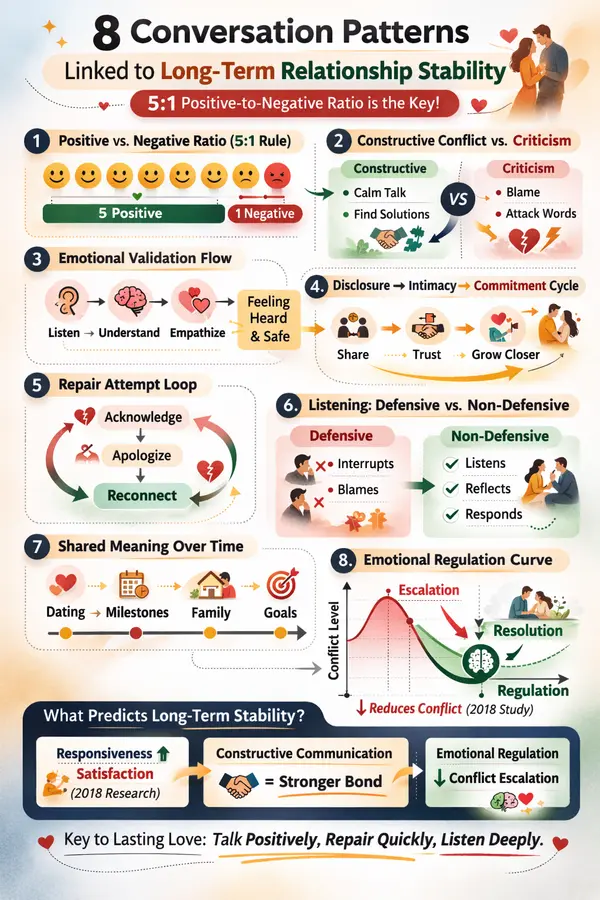
III. Pattern 1: A Strong Positive-to-Negative Interaction Ratio
One of the most replicated findings in relationship research comes from longitudinal work conducted by psychologist John Gottman. Couples who maintain stable relationships typically display a significantly higher ratio of positive to negative interactions during both everyday exchanges and conflict discussions.
Positive interactions include:
- Expressions of appreciation
- Humor
- Affection
- Verbal support
- Gentle tone during disagreement
The predictive power lies not in eliminating negativity, but in ensuring that positive emotional deposits outweigh critical or dismissive interactions over time.
IV. Pattern 2: Constructive Conflict Framing
Conflict itself is not predictive of relationship failure. Instead, the framing of conflict is critical.
Constructive conflict framing involves:
- Addressing behaviors instead of attacking character
- Framing issues as shared problems
- Using neutral or collaborative language
In contrast, partner-focused criticism (“you always…”) predicts defensiveness and long-term dissatisfaction.
Constructive framing predicts longevity because it preserves mutual respect while addressing disagreement.
V. Pattern 3: Emotional Validation During Disagreement
Validation does not require agreement. It involves acknowledging a partner’s internal experience as understandable, even when perspectives differ.
Validation helps regulate emotional intensity during conflict. When one partner feels heard, physiological stress responses decline, which reduces escalation risk. Over years, repeated validation builds emotional trust, lowering the likelihood of chronic resentment.
VI. Pattern 4: Open Emotional Disclosure
Emotional disclosure refers to sharing vulnerable thoughts, fears, or personal experiences rather than maintaining emotional distance.
A 2019 study published in Frontiers in Psychology found that emotional self-disclosure predicts intimacy and commitment across relationship stages.
Long-term couples often continue sharing evolving internal experiences rather than assuming familiarity replaces vulnerability. When disclosure remains ongoing, partners maintain psychological closeness even as life circumstances change.
Longevity is associated with sustained vulnerability not just early-stage openness.
VII. Pattern 5: Repair Attempts After Misunderstandings
Repair attempts are statements or behaviors intended to de-escalate tension during or after conflict. Examples include:
- Humor used to soften intensity
- Acknowledging partial responsibility
- Expressing affection mid-discussion
- Proposing a pause
Crucially, successful repair depends on partner receptiveness. Couples who accept repair attempts rather than dismiss them show significantly higher stability in longitudinal studies.
Repair attempts interrupt negative cycles before they compound over time.
VIII. Pattern 6: Non-Defensive Listening
Defensiveness predicts long-term dissatisfaction more reliably than many other negative behaviors. Listening with the goal of protecting oneself rather than understanding the partner increases emotional distance.
A 2021 review in Current Directions in Psychological Science highlights defensiveness as a key escalation factor in intimate relationships
Non-defensive listening involves:
- Allowing feedback without immediate counterattack
- Asking clarifying questions
- Avoiding tone escalation
- Distinguishing critique from rejection
Over time, repeated non-defensive responses reinforce psychological safety and reduce anticipatory anxiety around conflict conversations.
IX. Pattern 7: Shared Meaning-Making Conversations
Long-term couples frequently engage in conversations about shared identity, future goals, values, and life narratives.
These conversations include:
- Discussing future plans
- Reflecting on shared milestones
- Articulating mutual values
- Defining what the relationship represents
Shared meaning-making predicts longevity because it strengthens relational identity beyond immediate emotions.
X. Pattern 8: Emotional Regulation During Difficult Conversations
Emotional regulation refers to the ability to manage physiological arousal and emotional intensity during stressful exchanges.
Couples who demonstrate:
- Slower escalation
- Reduced contempt
- Lower physiological flooding
- Ability to pause without withdrawal
show greater long-term stability.
Importantly, emotional regulation functions both individually and relationally. Partners often co-regulate meaning one partner’s calm tone influences the other’s physiological response.
XI. How These Patterns Interact Over Time
These patterns rarely operate in isolation.
For example:
- Positive interaction ratios increase the likelihood that repair attempts are accepted.
- Emotional validation reduces defensiveness.
- Emotional regulation makes constructive framing possible.
- Shared meaning conversations reinforce motivation to resolve conflict respectfully.
Over time, communication patterns become self-reinforcing cycles. Stable couples tend to develop upward spirals of constructive interaction, while distressed couples may develop negative feedback loops.
Longevity appears less about isolated behaviors and more about repeated relational patterns that compound over years.
XII. Common Misinterpretations About Communication and Longevity
Myth 1: Happy Couples Don’t Argue
Research consistently shows that conflict frequency alone does not predict breakup. The style and tone of disagreement matter more than its presence.
Myth 2: Compatibility Eliminates Communication Effort
Even highly compatible couples experience stressors. Longevity correlates more strongly with communication patterns than personality similarity.
Myth 3: Intensity Equals Closeness
High emotional intensity without regulation often predicts volatility rather than stability.
XIII. Conclusion
Relationship longevity is rarely determined by dramatic turning points. Instead, it emerges from recurring conversational patterns that shape emotional climate over time.
The eight predictive patterns include:
- A strong positive-to-negative interaction ratio
- Constructive conflict framing
- Emotional validation
- Ongoing emotional disclosure
- Effective repair attempts
- Non-defensive listening
- Shared meaning-making conversations
- Emotional regulation during difficulty
These patterns are measurable, research-backed, and consistently linked to long-term relationship satisfaction and stability. They illustrate that the structure of everyday conversations not the absence of disagreement is one of the strongest predictors of whether relationships endure.
Frequently Asked Questions:
1. What are conversation patterns in relationships?
Conversation patterns are recurring ways partners communicate over time. These include how they handle conflict, express emotions, respond to criticism, offer validation, and repair misunderstandings. Unlike isolated disagreements, patterns are repeated interaction styles that shape long-term relationship dynamics.
2. Can communication patterns really predict relationship longevity?
Research in relationship psychology suggests that consistent communication behaviors—such as emotional validation, constructive conflict framing, and positive interaction ratios—are strong predictors of long-term stability and satisfaction. Patterns often matter more than individual arguments.
3. Is arguing a sign that a relationship won’t last?
Not necessarily. Studies show that the frequency of arguments alone does not predict breakup. The tone, framing, emotional regulation, and repair efforts during conflict are more important indicators of long-term outcomes.
4. What is the positive-to-negative interaction ratio?
The positive-to-negative interaction ratio refers to the balance of supportive, affectionate, or respectful exchanges compared to critical or negative ones. Research suggests that stable couples tend to maintain significantly more positive than negative interactions over time.
5. How does emotional validation affect relationship stability?
Emotional validation helps partners feel understood and psychologically safe. When individuals feel heard during disagreements, stress responses decrease, which reduces escalation and builds long-term trust.
6. What are repair attempts in communication?
Repair attempts are efforts to de-escalate tension during or after conflict. These can include humor, expressions of affection, acknowledging responsibility, or proposing a pause. Successful repair attempts are associated with greater relationship resilience.
7. Why is defensiveness harmful in long-term relationships?
Defensiveness often escalates conflict and reduces emotional safety. When partners consistently respond with counterattacks or justification instead of listening, conversations become adversarial rather than collaborative.
8. Do communication patterns change over time?
Yes. Communication patterns can evolve due to life stressors, personal growth, or shifting relationship dynamics. However, long-term stability is typically associated with consistent constructive patterns rather than fluctuating extremes.
9. Is compatibility more important than communication?
While compatibility influences attraction and shared interests, research consistently shows that communication patterns are stronger predictors of long-term satisfaction and stability than personality similarity alone.
10. Can strong communication patterns offset major differences between partners?
Constructive communication patterns can help couples navigate differences in values, personality, or lifestyle. While communication does not eliminate incompatibility, it significantly influences how differences are managed over time.