In romantic relationships, what is said often matters less than when it is said. A concern raised during a calm evening can lead to thoughtful dialogue, while the same concern expressed during stress or emotional escalation may trigger defensiveness. Emotional timing the alignment between emotional readiness and conversational initiation plays a powerful but often overlooked role in relationship outcomes.
Timing is distinct from tone and content. Two partners may use respectful language and clear reasoning, yet if the conversation occurs during emotional flooding or cognitive overload, the discussion may still deteriorate. Research in relationship psychology consistently shows that emotional regulation, stress levels, and attachment dynamics influence how receptive individuals are at any given moment.
Understanding emotional timing helps explain why certain conversations strengthen intimacy while others erode it even when the topic remains the same.
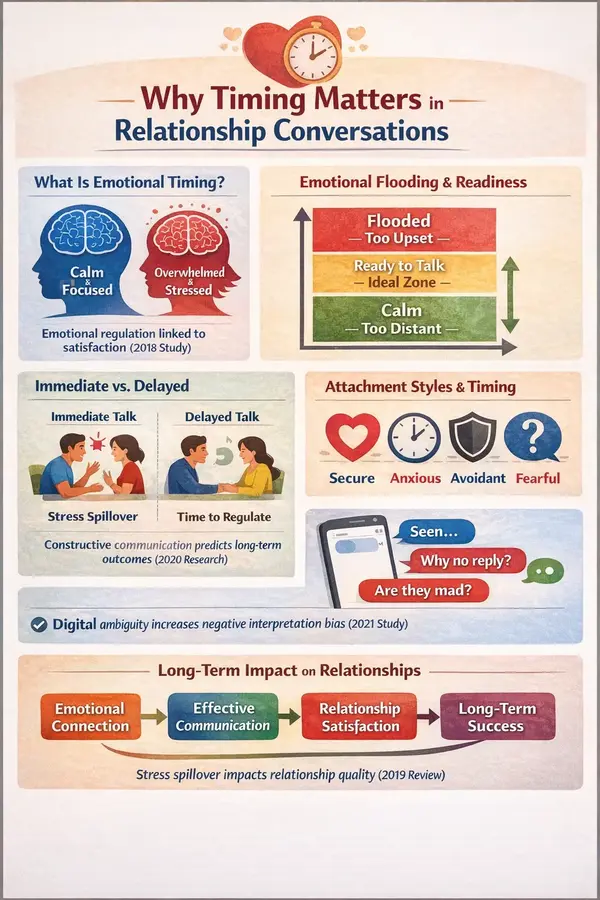
What Is Emotional Timing?
Emotional timing refers to the alignment between:
- A partner’s emotional state
- Environmental context
- Cognitive availability
- The urgency or sensitivity of the topic
It includes both readiness and receptivity.
Timing as Readiness
Readiness involves whether both partners are emotionally regulated enough to engage constructively. If one partner is stressed, fatigued, or overwhelmed, their ability to process nuanced discussion decreases.
Timing as Context
Context includes location, privacy, external pressures, and competing demands. A serious conversation initiated before work or during a social event may produce different outcomes than one initiated during quiet, uninterrupted time.
Immediate vs. Delayed Conversations
Some conversations occur spontaneously in response to an event. Others are delayed intentionally. Both approaches carry psychological implications.
Also read: The Psychology of Emotional Expression in Romantic Partnerships
Emotional Regulation and Conversational Readiness
Emotional timing is closely linked to physiological regulation.
When individuals experience emotional flooding elevated heart rate, cortisol release, narrowed cognitive focus they become less capable of processing complex emotional information.
High arousal reduces:
- Listening accuracy
- Empathy
- Cognitive flexibility
- Problem-solving ability
In contrast, regulated emotional states increase responsiveness and constructive framing.
Thus, timing a conversation during periods of lower physiological stress increases the likelihood of mutual understanding.
Immediate Expression vs. Delayed Processing
Romantic partners differ in their preferences for conversational immediacy.
Immediate Expression
Some individuals prefer to address concerns as soon as they arise. Benefits may include:
- Reduced rumination
- Clearer memory of events
- Faster resolution
However, if emotional arousal is high, immediate confrontation can escalate intensity.
Delayed Processing
Others prefer time to reflect before speaking. Benefits may include:
- More structured articulation
- Lower emotional reactivity
- Reduced impulsive statements
Yet excessive delay may increase anxiety or lead to misinterpretation.
Timing effectiveness depends on emotional readiness rather than urgency alone.
Timing During Conflict Escalation
Conflict follows predictable escalation curves:
- Minor irritation
- Defensive responses
- Intensified emotion
- Potential shutdown or hostility
Initiating a serious conversation at stage three during peak escalation reduces constructive resolution likelihood.
Research summarized by The Gottman Institute suggests that couples who pause during heightened arousal and resume discussion after regulation show better long-term stability.
Repeated poorly timed conversations reinforce escalation cycles. Over time, partners may associate serious topics with emotional volatility rather than safety.
Effective timing interrupts escalation rather than amplifying it.
Attachment Styles and Timing Sensitivity
Attachment patterns significantly influence perceptions of timing.
Anxious Attachment
Individuals with anxious attachment tendencies often prefer immediate reassurance and rapid discussion. Delays may trigger uncertainty or abandonment fears.
Avoidant Attachment
Avoidantly attached individuals often prefer emotional distance before engaging. Immediate confrontation may feel intrusive or overwhelming.
Secure Attachment
Securely attached partners typically display flexibility, adjusting timing based on context and regulation capacity.
When timing preferences clash, one partner may interpret delay as indifference while the other interprets urgency as pressure.
Read more: What Attachment Styles Are and How They Shape Adult Relationships
Life Stressors and External Timing Pressures
External stress significantly affects conversational receptivity.
Common timing disruptors include:
- Work deadlines
- Parenting responsibilities
- Financial strain
- Health concerns
High cognitive load reduces emotional bandwidth. Research in relationship stress models suggests that external stress predicts lower patience and increased conflict spillover (Lavner & Bradbury, 2019, Current Opinion in Psychology.
Timing conversations during peak stress increases the risk of misinterpretation.
Environmental distractions television, phones, multitasking also fragment attention, reducing emotional attunement.
Digital Timing in Modern Relationships
Digital communication introduces new timing complexities.
Text messages are asynchronous, meaning responses may not occur immediately. Research in Computers in Human Behavior (Hall et al., 2021) indicates that delayed digital responses can increase ambiguity and negative interpretation bias.
Digital timing challenges include:
- Reading tone without context
- Interpreting delayed replies as avoidance
- Initiating conflict via text rather than in person
Because digital platforms lack nonverbal cues, timing misinterpretations may intensify emotional reactions.
Cultural and Social Norms Around Timing
Cultural norms shape expectations about emotional pacing.
In some cultures, immediate discussion is viewed as honest and mature. In others, restraint and delayed processing are associated with respect and self-control.
Family modeling also influences timing habits:
- Households that addressed issues immediately may normalize urgency.
- Households that avoided confrontation may normalize delay.
Gender socialization can contribute to timing differences. Research in Current Directions in Psychological Science (Chaplin, 2019) notes that emotional expression norms vary across genders, potentially influencing pacing preferences
Understanding these influences helps contextualize timing differences without assuming intentional harm.
The Long-Term Impact of Repeated Timing Patterns
Timing patterns accumulate.
Repeated poorly timed conversations can:
- Reinforce defensive cycles
- Increase anticipatory anxiety
- Reduce willingness to engage
Conversely, consistent alignment between emotional readiness and discussion timing builds predictability and safety.
Over time, couples often develop informal patterns around when serious topics are addressed. When these patterns support regulation and attentiveness, satisfaction tends to increase.
Timing becomes part of relational culture.
Common Misconceptions About Timing in Relationships
Myth 1: Immediate Discussion Is Always Healthier
Immediate discussion during emotional flooding can increase escalation.
Myth 2: Waiting Always Reduces Conflict
Excessive delay may intensify rumination or perceived avoidance.
Myth 3: Important Topics Must Be Addressed Instantly
Importance does not override emotional readiness.
Effective timing depends on regulation, context, and mutual receptivity—not urgency alone.
Conclusion
Emotional timing functions as an invisible variable in romantic communication. The same words can produce connection or conflict depending on when they are delivered.
Research suggests that effective timing aligns with:
- Emotional regulation
- Lower physiological arousal
- Reduced external stress
- Mutual receptivity
Attachment patterns, stress levels, digital communication, and cultural norms all influence timing dynamics.
Over time, repeated timing patterns either reinforce emotional safety or contribute to escalating cycles. Conversations do not exist in isolation they are embedded within physiological states, environmental pressures, and relational history.
In romantic partnerships, timing is not a minor detail. It is a structural component of how understanding, trust, and stability develop.
Frequently Asked Questions:
1. What does emotional timing mean in a relationship?
Emotional timing refers to when a conversation is initiated relative to each partner’s emotional state, stress level, and cognitive readiness. It focuses on receptivity and regulation rather than just what is being discussed.
2. Why does timing affect how conversations unfold?
When emotions are elevated or stress levels are high, cognitive flexibility and listening accuracy decrease. Conversations initiated during emotional flooding are more likely to escalate than those initiated during calm, regulated states.
3. Is it better to address issues immediately or wait?
Neither approach is universally better. Immediate discussion may reduce rumination but can escalate if emotions are intense. Delayed discussion can improve clarity but may increase anxiety if extended too long. Effectiveness depends on emotional readiness.
4. How does attachment style influence timing preferences?
Individuals with anxious attachment tendencies often prefer immediate resolution, while those with avoidant tendencies may prefer emotional space before discussing issues. Secure attachment is typically associated with greater flexibility around timing.
5. Can poor timing create long-term relationship problems?
Yes. Repeatedly initiating conversations during peak stress or escalation can reinforce defensive cycles. Over time, this pattern may reduce emotional safety and increase anticipatory tension around serious discussions.
6. How do external stressors influence conversational timing?
Work pressure, parenting demands, financial concerns, and health stress can reduce emotional bandwidth. Conversations initiated during high external stress are more likely to be misinterpreted or poorly received.
7. Why is digital timing often misinterpreted?
Digital communication lacks tone and facial cues, so delayed responses may be perceived as avoidance or indifference. Asynchronous messaging increases ambiguity about emotional intent.
8. Does emotional timing matter in long-term relationships?
Yes. Long-term stability is often shaped by repeated patterns of when and how difficult topics are addressed. Consistent alignment between emotional readiness and conversation timing can strengthen predictability and trust.
9. What is emotional flooding, and how does it relate to timing?
Emotional flooding refers to heightened physiological arousal such as increased heart rate and stress hormones—that reduces the ability to process complex emotional information. Conversations during flooding often escalate rather than resolve issues.
10. Can partners develop shared timing patterns over time?
Yes. Many couples gradually establish informal norms about when serious topics are discussed. When these patterns support regulation and attentiveness, they often contribute to long-term satisfaction and relational stability.