Physical affection is often treated as a simple expression of love. Yet in close relationships, small gestures like the way someone hugs can reveal deeper emotional patterns. While no single action defines a person’s attachment style or emotional capacity, repeated patterns of physical closeness often mirror how comfortable someone feels with vulnerability, intimacy, and connection.
This article explores how different hugging styles may reflect emotional availability through the lens of attachment theory, nonverbal communication research, and contemporary relationship science.
Emotional Availability: A Conceptual Overview
Emotional availability refers to a person’s capacity to be emotionally present, responsive, and engaged within a relationship. Researchers generally describe it through four interrelated qualities:
- Responsiveness – reacting to a partner’s emotional cues
- Consistency – showing stable patterns of affection and support
- Attunement – recognizing and validating emotional states
- Vulnerability – allowing emotional openness
Attachment theory provides a useful framework for understanding these patterns. Originally developed by John Bowlby and later expanded by Mary Ainsworth, attachment theory explains how early caregiving experiences influence adult intimacy patterns.
A 2018 review in Current Opinion in Psychology noted that adult attachment orientations consistently predict relationship behaviors, emotional regulation strategies, and intimacy comfort levels (Mikulincer & Shaver, 2018).
Source: Mikulincer, M., & Shaver, P. R. “Attachment orientations and emotion regulation.” Current Opinion in Psychology.
Emotional availability is not about how often someone expresses affection. It is about how safe and comfortable they feel doing so.
The Psychology of Hugs: What Research Suggests
Touch is one of the most powerful nonverbal attachment signals. Research shows that physical affection can:
- Reduce cortisol (stress hormone)
- Increase oxytocin (bonding hormone)
- Improve perceived relational security
A 2020 study published in PLOS ONE found that hugging can buffer stress responses during conflict situations and improve emotional regulation.
Source: Packheiser et al., “Hugging could mitigate the negative mood that follows interpersonal conflict.” PLOS ONE, 2020.
The duration, body positioning, and emotional presence during a hug may therefore reflect underlying comfort with closeness and co-regulation.
However, cultural norms and personality differences also influence touch. Context always matters.
Common Hug Styles and What They May Reflect
These interpretations reflect patterns not diagnoses.
1. The Full-Body, Sustained Hug
Description:
Both partners fully engage, bodies aligned, arms wrapped securely, often held for several seconds or longer.
Possible Emotional Meaning:
- Comfort with closeness
- Emotional attunement
- Willingness to pause and connect
This style is often associated with secure attachment patterns. Securely attached individuals generally display comfort with intimacy and independence, balancing physical closeness without fear or withdrawal.
2. The Side Hug or Half-Embrace
Description:
One arm around the shoulder or waist, partial body contact, often brief.
Possible Emotional Meaning:
- Situational boundary maintenance
- Mild emotional guardedness
- Preference for lower-intensity intimacy
Side hugs are common in public settings or early dating phases. They may reflect reserved personality traits rather than emotional unavailability.
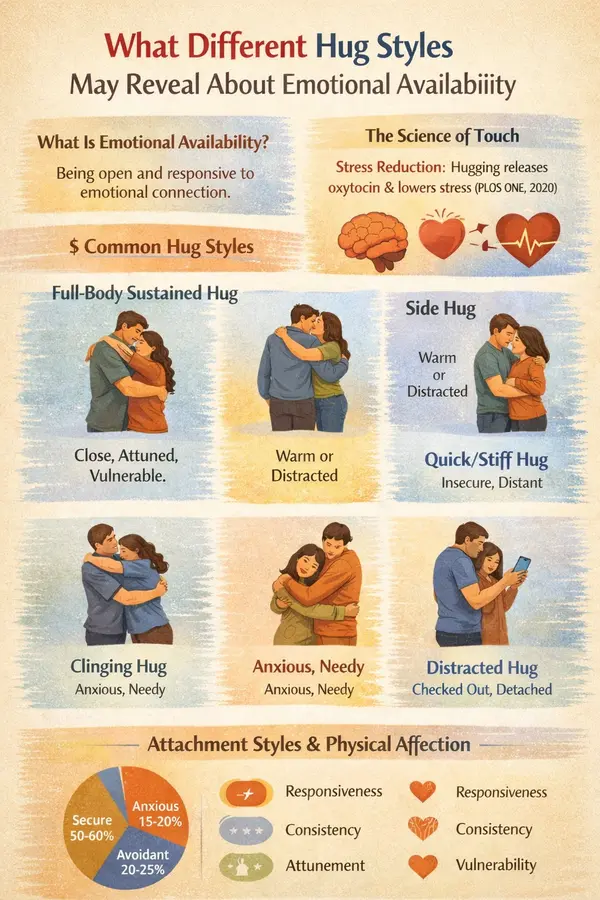
3. The Quick, Tension-Filled Hug
Description:
Brief contact, minimal pressure, stiff posture.
Possible Emotional Meaning:
- Discomfort with vulnerability
- Avoidant attachment tendencies
- Emotional distraction or stress
Avoidantly attached individuals often value autonomy and may feel uncomfortable with prolonged physical closeness. Research shows they are more likely to deactivate emotional responses when intimacy increases (Fraley & Shaver, 2016).
However, stress and environmental distraction can also cause stiffness isolated moments are not definitive indicators.
4. The Overly Tight or Clinging Hug
Description:
Intense grip, extended duration, sometimes accompanied by reluctance to release.
Possible Emotional Meaning:
- Heightened reassurance-seeking
- Fear of emotional distance
- Anxiety about connection stability
Individuals with anxious attachment patterns often seek reassurance through proximity and physical closeness. A 2019 review in Journal of Social and Personal Relationships found that anxiously attached adults may use physical affection to reduce perceived insecurity in relationships.
This style may feel deeply affectionate or overwhelming depending on the relational dynamic.
5. The One-Armed or Distracted Hug
Description:
One arm loosely placed while attention remains elsewhere (phone, surroundings, conversation).
Possible Emotional Meaning:
- Divided emotional presence
- Habitual rather than intentional affection
- Reduced engagement in the moment
Emotional availability includes attentiveness. When physical gestures lack attention, it may reflect broader patterns of emotional disengagement.
Again, context matters fatigue, multitasking, or personality differences can explain occasional distracted affection.
Attachment Styles and Physical Expression
Secure Attachment
Secure individuals typically display relaxed, natural affection. They are comfortable with both closeness and independence. Their hugs often feel steady rather than intense or distant.
Anxious Attachment
Anxiously attached individuals may seek prolonged physical contact to reassure themselves of connection. They may be sensitive to changes in hugging frequency or warmth.
Avoidant Attachment
Avoidant individuals may prefer shorter or less intimate hugs. They might feel overwhelmed by prolonged closeness, especially during emotionally charged moments.
Fearful-Avoidant Attachment
This mixed style may produce inconsistent hugging patterns sometimes intensely affectionate, sometimes withdrawn. These fluctuations often mirror internal ambivalence about closeness.
Context Matters: Avoiding Overinterpretation
Physical affection does not exist in isolation. Consider:
- Cultural background
- Family norms around touch
- Personality traits (introversion vs. extroversion)
- Stress levels
- Public vs. private settings
Love language research, though debated in academic circles, suggests individuals vary significantly in how they prioritize physical touch (Egbert & Polk, 2006).
One hug cannot define emotional availability. Patterns over time provide clearer insight.
Patterns Over Moments: Identifying Consistency
Emotional availability is revealed through:
- Repeated responsiveness
- Emotional presence during stress
- Consistency between words and actions
- Willingness to engage in difficult conversations
A hug may reinforce these patterns but rarely replaces them.
For example:
- A partner who offers sustained hugs after conflict and engages in repair conversations likely demonstrates emotional openness.
- A partner who avoids both physical and emotional closeness over time may reflect broader intimacy discomfort.
Consistency matters more than isolated behavior.
When Physical Affection and Emotional Signals Don’t Match
Some partners display high physical affection but low emotional depth. Others provide emotional support but limited physical closeness.
Misalignment can occur when partners have different attachment needs. For instance:
- Anxious partner: “Physical closeness means reassurance.”
- Avoidant partner: “Closeness feels overwhelming.”
Understanding these patterns reduces misinterpretation.
The Broader Lens: Nonverbal Communication in Modern Relationships
In digital-first dating cultures, nonverbal cues are increasingly limited to in-person interactions. When physical time together is reduced, gestures like hugging carry amplified emotional meaning.
Touch remains one of the few universally recognized bonding behaviors across cultures. However, emotional availability ultimately requires more than physical proximity it requires psychological presence.
Conclusion
The way your partner hugs you may offer subtle clues about their comfort with intimacy, vulnerability, and connection. Sustained, relaxed hugs often reflect emotional security. Brief or distant hugs may indicate boundaries, distraction, or avoidant tendencies. Intense clinging hugs may signal reassurance-seeking.
Yet no single gesture defines emotional availability.
Emotional presence reveals itself through consistent responsiveness, attunement, and willingness to engage not through one moment of physical contact.
A hug is data. Patterns tell the story.
Frequently Asked Questions:
1. Can the way someone hugs really indicate emotional availability?
Hugging style can reflect comfort with closeness, vulnerability, and physical intimacy. However, emotional availability is better understood through consistent patterns of responsiveness and engagement over time rather than a single gesture.
2. What does a long, tight hug usually mean in a relationship?
A sustained, relaxed hug often reflects comfort with emotional and physical closeness. In some cases, especially when unusually intense, it may also indicate reassurance-seeking behaviors linked to attachment anxiety.
3. Are short or stiff hugs a sign of emotional unavailability?
Not necessarily. Brief or tense hugs can result from stress, distraction, personality differences, or cultural norms. When consistently paired with emotional distance, they may reflect discomfort with intimacy.
4. How are attachment styles connected to physical affection?
Attachment styles influence how individuals regulate closeness and independence. Secure attachment is typically associated with balanced affection, anxious attachment with heightened proximity-seeking, and avoidant attachment with reduced comfort in prolonged physical closeness.
5. Can someone be emotionally available but not physically affectionate?
Yes. Emotional availability involves responsiveness, empathy, and consistency. Some individuals express emotional presence through conversation and support rather than frequent physical touch.
6. Do cultural differences affect hugging behavior?
Yes. Cultural norms strongly shape attitudes toward physical affection. In some cultures, prolonged hugging is common, while in others it may be reserved for private settings or close family relationships.
7. Is hugging important for relationship bonding?
Research suggests that affectionate touch can reduce stress hormones and increase oxytocin, which supports bonding and emotional regulation. However, bonding also depends on communication, trust, and shared experiences.
8. What if my partner’s hugging style changes over time?
Changes in physical affection may reflect shifts in stress levels, emotional states, life circumstances, or relationship dynamics. Patterns over time provide more insight than isolated changes.
9. Can attachment styles change within a relationship?
Attachment patterns can evolve, especially in relationships characterized by safety, consistency, and emotional responsiveness. While early experiences influence attachment, adult relationships also shape it.
10. Should hugging style be used to judge relationship health?
Hugging style can offer clues about comfort with intimacy, but it should not be used as a standalone measure of relationship health. Emotional availability is better assessed through consistent communication, mutual understanding, and reliability.