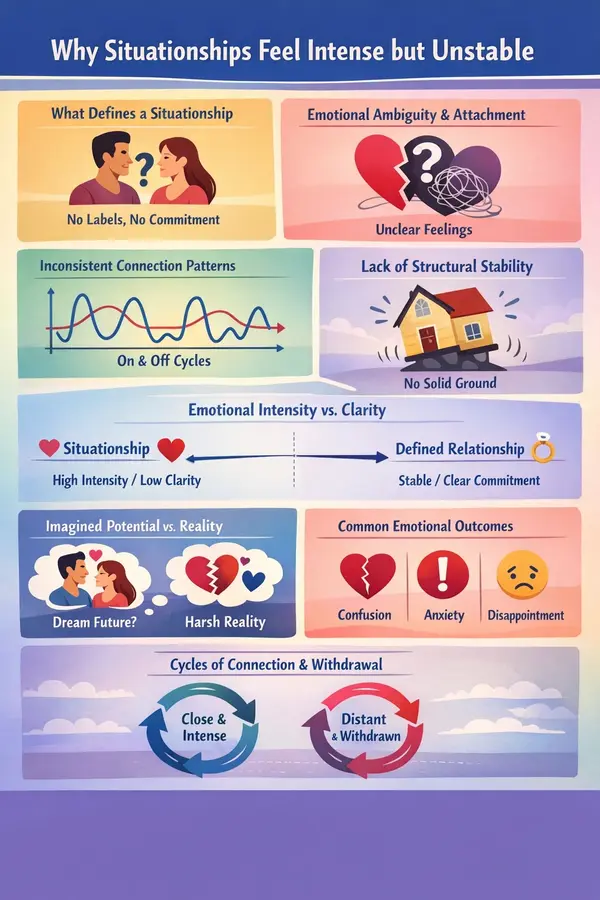
Situationships have become a familiar feature of modern dating. They often feel emotionally charged, deeply consuming, and meaningful yet at the same time fragile, confusing, and difficult to sustain. Many people describe being surprised by how strong their feelings become in a relationship that lacks clear definition or long-term commitment. The combination of intensity and instability is not accidental. It emerges from a specific set of emotional, psychological, and social dynamics that shape how situationships function.
Understanding why situationships feel this way requires looking beyond individual behavior and toward the structure of the dynamic itself. Intensity and instability are not opposites here; they often reinforce each other.
Defining the Situationship Context
A situationship generally refers to a romantic or emotionally intimate connection that exists without explicit labels, shared expectations, or clearly defined boundaries. It often sits somewhere between casual dating and a committed relationship, without fully aligning with either.
Unlike traditional relationships, situationships lack agreed-upon milestones such as exclusivity, long-term planning, or mutual accountability. Unlike casual dating, they often involve emotional intimacy, vulnerability, and regular contact. This combination creates a paradox: emotional closeness without structural clarity.
It is within this undefined space that both intensity and instability take root.
Also read: Situationships Explained: Where Ambiguity Fits in Modern Dating
Emotional Ambiguity as an Intensity Amplifier
One of the defining characteristics of situationships is emotional ambiguity. When expectations, intentions, and future possibilities are unclear, people tend to fill in the gaps themselves.
Ambiguity encourages heightened emotional focus. Small gestures texts, plans, expressions of care can take on outsized meaning because they are not anchored to a clear relational framework. Without clarity, individuals often analyze tone, timing, and frequency, searching for reassurance or evidence of progress.
This constant interpretation intensifies emotional engagement. Rather than emotions settling into a steady rhythm, they remain elevated, reactive, and highly sensitive to change.
Intermittent Reinforcement and Emotional Highs
Situationships frequently involve inconsistent patterns of connection. Periods of closeness may be followed by distance, reduced communication, or emotional withdrawal. This inconsistency can unintentionally strengthen emotional attachment.
When affection and attention are unpredictable, moments of connection can feel especially rewarding. The contrast between absence and presence amplifies emotional highs, making them feel more meaningful than they might in a stable relationship.
Over time, this pattern can create a cycle:
- Emotional closeness builds hope and attachment
- Distance introduces uncertainty and longing
- Reconnection provides relief and emotional intensity
The emotional peaks and valleys reinforce one another, deepening the sense of intensity while undermining stability.
The Absence of Structural Stability
Stability in relationships is not created by emotion alone. It also comes from structure shared definitions, boundaries, and expectations that provide a sense of safety and predictability.
Situationships typically lack this structure. There may be no shared understanding of exclusivity, future plans, or emotional responsibility. Without these anchors, the relationship remains vulnerable to sudden shifts.
Even when emotional intimacy is strong, the absence of structure means there is little to prevent the connection from changing abruptly. This creates a persistent sense of instability beneath the surface intensity.
Emotional Investment Without Security
Situationships often involve significant emotional investment. People may share personal stories, offer support, and develop routines that resemble those found in committed relationships.
However, this investment is not always matched by emotional security. Without mutual assurances or shared commitments, vulnerability can feel risky. Emotional energy is given without knowing whether it will be reciprocated or sustained.
This imbalance deep emotional involvement without reliable security contributes to the instability many people experience. The relationship feels important, but its future feels uncertain.
The Role of Imagined Potential
Another source of intensity in situationships is the role of imagined potential. Without clear boundaries, it can be easy to focus on what the relationship could become rather than what it currently is.
Potential fills the space left by ambiguity. Hopes, assumptions, and unspoken expectations can create a powerful emotional narrative that enhances attachment. The relationship feels meaningful not only because of present experiences, but because of the future possibilities attached to them.
When reality does not align with this imagined trajectory, instability becomes more apparent. The tension between expectation and experience can fuel confusion and emotional strain.
Mixed Signals and Conflicting Cues
Situationships are often marked by mixed signals—behaviors that suggest closeness paired with actions that maintain distance. For example, consistent emotional intimacy may coexist with reluctance to define the relationship or make plans.
These conflicting cues sustain intensity by keeping hope alive while simultaneously preventing resolution. Emotional signals suggest connection, while behavioral signals introduce doubt.
The ongoing effort to interpret these signals can be emotionally draining. It keeps individuals psychologically engaged, but without offering clarity or reassurance.
Cultural and Social Influences
Modern dating culture plays a significant role in shaping situationships. Digital communication, dating apps, and shifting norms around commitment have normalized relationship ambiguity.
In this context, undefined connections are often socially acceptable, even expected. Emotional intimacy can develop quickly through constant messaging and shared vulnerability, while commitment remains optional.
This cultural backdrop can intensify situationships by encouraging closeness without obligation. The result is emotional depth without corresponding stability.
Why Intensity Can Mask Instability
One reason situationships persist is that emotional intensity can be mistaken for relationship strength. Strong feelings, frequent communication, and shared vulnerability may create the impression of security, even when structural stability is absent.
Intensity feels meaningful and validating. It can temporarily overshadow concerns about clarity or commitment. However, intensity alone does not provide long-term reliability.
Over time, the lack of foundation often becomes harder to ignore. What once felt exciting may begin to feel uncertain or emotionally taxing.
Common Emotional Patterns Over Time
As situationships continue, certain emotional patterns frequently emerge:
- Attachment deepens without corresponding progression
- Reassurance is sought but not consistently provided
- Emotional fatigue develops from ongoing uncertainty
Without change, the relationship may reach a plateau where intensity remains high but satisfaction declines. This often leads to frustration, disengagement, or eventual dissolution.
Situationships in the Broader Relationship Landscape
Situationships are not inherently dysfunctional. For some, they represent a transitional phase or a reflection of personal timing and circumstances. However, their structure makes them particularly prone to the combination of intensity and instability.
The key distinction between situationships and more sustainable relationships lies in alignment between emotion and structure, investment and security, connection and clarity.
Understanding these dynamics can help explain why situationships feel so powerful, yet so difficult to maintain over time.
Frequently Asked Questions:
1. Why do situationships feel more intense than traditional relationships?
Situationships often involve emotional closeness without clear structure. The lack of defined expectations can heighten focus on small interactions, making emotions feel stronger and more consuming than in clearly defined relationships.
2. Is emotional intensity a sign that a situationship is meaningful?
Emotional intensity reflects strong feelings, but it does not necessarily indicate stability or long-term compatibility. Intensity can arise from uncertainty, emotional ambiguity, or inconsistent connection rather than relational security.
3. Why do situationships feel unstable over time?
Instability often comes from the absence of shared boundaries, commitment, and future clarity. Without these elements, emotional closeness exists without a framework to support consistency or reliability.
4. How do mixed signals contribute to situationship dynamics?
Mixed signals such as emotional availability paired with avoidance of definition—can sustain hope while preventing clarity. This keeps emotional engagement high but reinforces uncertainty.
5. Can situationships develop into stable relationships?
Some situationships evolve into defined relationships, but this depends on alignment in expectations, intentions, and communication. Without structural changes, the same intensity–instability pattern often continues.
6. Why is uncertainty emotionally engaging in situationships?
Uncertainty can amplify emotional attention and attachment. When outcomes are unclear, people tend to invest more emotionally as they seek reassurance, meaning, or validation.
7. Are situationships more common in modern dating?
Situationships have become more visible in modern dating environments shaped by digital communication, flexible relationship norms, and delayed commitment timelines.
8. What is the difference between emotional closeness and relationship stability?
Emotional closeness involves intimacy and connection, while stability comes from consistency, mutual understanding, and shared expectations. Situationships often have the former without the latter.
9. Why do situationships often lead to emotional fatigue?
Sustained ambiguity, repeated interpretation of signals, and lack of progression can create emotional strain over time, even when feelings remain strong.
10. Is instability an inherent feature of situationships?
While not universal, instability is common because situationships are defined by unclear structure. Without intentional clarification, emotional intensity tends to coexist with ongoing uncertainty.