Betrayal in romantic relationships whether emotional, physical, or digital disrupts one of the core foundations of partnership: the expectation of safety and reliability. Unlike gradual trust erosion, betrayal often feels abrupt and destabilizing. It can fundamentally shift how one partner perceives the other’s intentions, honesty, and dependability.
Yet not all relationships end after betrayal. Longitudinal research studies that follow couples over time suggests that recovery is possible under certain conditions. Trust rebuilding does not hinge on a single apology or emotional conversation. Instead, it unfolds gradually through consistent behavioral patterns, emotional responsiveness, and time.
Understanding what research reveals about post betrayal recovery helps clarify why some couples stabilize while others continue to experience chronic instability.
What Happens Psychologically After Betrayal
Betrayal activates a powerful psychological response.
Threat Response Activation
Romantic betrayal often triggers the same neural threat systems associated with physical danger. Individuals may experience:
- Heightened anxiety
- Intrusive thoughts
- Rumination
- Emotional volatility
Attachment System Activation
Attachment research shows that betrayal can activate deep fears of abandonment or rejection. According to Overall and Simpson (2019) in Current Opinion in Psychology, attachment styles strongly influence how individuals process relational threat.
Hypervigilance
After betrayal, individuals often become hyper-alert to potential signs of further dishonesty. Neutral behaviors may be interpreted as suspicious due to heightened sensitivity.
Psychologically, betrayal alters baseline trust expectations. Recovery requires recalibrating these expectations through new experiences.
Also read: How Trust Erodes Over Time: Micro-Betrayals and Gradual Disconnection
The Immediate Aftermath: Instability and Ambiguity
In the short term, betrayal often creates instability.
Common early reactions include:
- Questioning the entire relationship history
- Oscillating between anger and longing
- Replaying events mentally
- Doubting one’s own judgment
Initial instability does not necessarily predict long-term outcome. Instead, recovery patterns become clearer through repeated interactions in the months that follow.
What Longitudinal Studies Reveal About Recovery Patterns
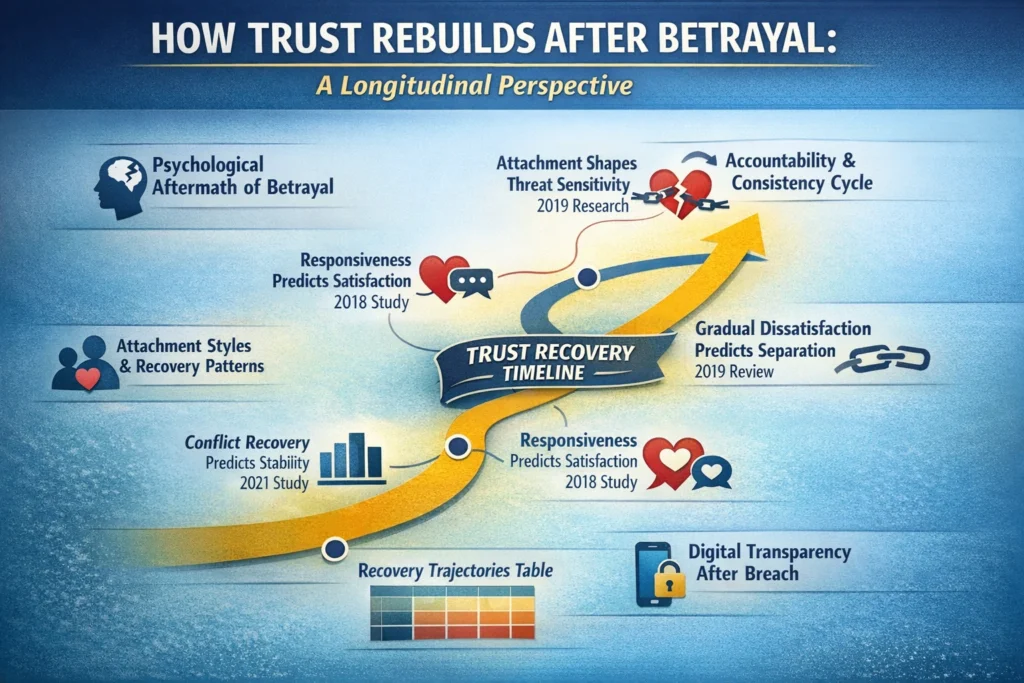
Longitudinal research highlights several recovery trajectories:
| Recovery Pattern | Characteristics | Long-Term Outlook |
|---|---|---|
| Gradual Stabilization | Emotional intensity decreases, consistent repair occurs | Increased likelihood of long-term reconciliation |
| Chronic Volatility | Repeated cycles of accusation and defensiveness | Elevated risk of separation |
| Emotional Withdrawal | Reduced conflict but increasing detachment | Gradual disengagement |
| Repeated Breach | Recurring violations | High instability |
Studies suggest that couples who demonstrate consistent behavioral change and emotional responsiveness are more likely to stabilize over time.
Time functions as a testing period during which new patterns either confirm change or reinforce suspicion.
Accountability and Behavioral Consistency
One of the strongest predictors of trust rebuilding is accountability.
Accountability includes:
- Clear acknowledgment of harm
- Avoidance of defensiveness
- Demonstrated behavioral change
- Consistent follow-through
Trust rebuilds when partners observe repeated alignment between stated intentions and actions. Inconsistent change prolongs hypervigilance.
Emotional Responsiveness and Reassurance
Perceived partner responsiveness plays a critical role in post-betrayal recovery.
After betrayal, responsiveness involves:
- Listening without defensiveness
- Acknowledging emotional pain
- Providing consistent reassurance
Emotional validation reduces threat activation and gradually lowers hypervigilance.
Reassurance must be sustained rather than episodic to support recalibration of trust.
Attachment Styles and Recovery Trajectories
Attachment patterns shape how betrayal is processed.
Anxious Attachment
Individuals with anxious attachment may experience prolonged hypervigilance and require frequent reassurance.
Avoidant Attachment
Avoidantly attached individuals may withdraw emotionally after betrayal, reducing vulnerability and discussion.
Secure Attachment
Securely attached individuals tend to combine accountability with structured repair efforts.
Longitudinal findings suggest that couples with secure attachment patterns are more likely to engage in consistent, constructive recovery behaviors.
Attachment differences can either amplify or stabilize post-betrayal dynamics.
The Role of Repair Attempts and Conflict Recovery
Repair attempts are essential after betrayal.
These may include:
- Clarification conversations
- Emotional check-ins
- Behavioral transparency
- Reassurance statements
Importantly, repair must be repeated. A single apology does not neutralize ongoing suspicion. Instead, repeated successful repair interactions gradually create new emotional associations.
Digital Transparency After Betrayal
Digital behavior often becomes central to post-betrayal rebuilding.
Common shifts include:
- Increased voluntary transparency
- Clarified digital boundaries
- Temporary visibility adjustments
Digital transparency may function as an interim stabilizer, but long-term trust rebuilding depends on reduced hypervigilance, not permanent surveillance.
Also read: Transparency in Relationships: Privacy, Boundaries, and Digital Access
Time, Pattern Recognition, and Trust Recalibration
Trust recalibration occurs gradually.
After betrayal, individuals mentally track new behavioral data. Each consistent interaction either supports rebuilding or reinforces doubt.
Key recalibration factors include:
- Predictability over months
- Emotional stability during conflict
- Consistent openness
- Absence of repeated breach
Longitudinal research suggests that stability often increases when couples maintain consistent positive-to-negative interaction patterns during conflict.
Trust is restored not through declarations, but through accumulated experiences.
When Trust Fails to Rebuild
Not all relationships recover after betrayal.
Predictors of unsuccessful rebuilding include:
- Continued defensiveness
- Repeated violations
- Emotional withdrawal
- Persistent suspicion without behavioral change
Chronic instability often reflects either insufficient accountability or unresolved hypervigilance cycles.
In some cases, separation follows prolonged failed repair attempts rather than immediate reaction.
Conclusion
Rebuilding trust after betrayal is a structured psychological process shaped by time, consistency, and emotional responsiveness.
Longitudinal studies suggest that recovery is more likely when couples demonstrate:
- Clear accountability
- Sustained behavioral alignment
- Emotional validation
- Repeated repair attempts
- Gradual reduction of hypervigilance
Trust does not return instantly. It recalibrates through repeated evidence of safety. Over time, consistent patterns either stabilize or destabilize the relationship.
The science of recovery emphasizes that rebuilding trust is less about dramatic gestures and more about sustained, predictable change observed across months and years.