Trust rarely collapses overnight. While dramatic betrayals such as confirmed infidelity can abruptly destabilize a relationship, most trust erosion occurs gradually. It unfolds through subtle, repeated experiences that slightly weaken emotional safety over time.
Many couples struggle to identify the exact moment trust began to decline. Instead, they describe a slow shift: conversations feel different, reassurance carries less weight, and emotional closeness diminishes. This process is often driven not by a single major breach, but by cumulative “micro-betrayals” small violations of expectation that, when repeated, reshape relational perception.
Understanding how trust erodes helps clarify why relationships sometimes feel distant long before a clear crisis emerges.
What Trust Erosion Means Psychologically
Psychologically, trust is an expectation of reliability and emotional safety. It forms when partners consistently demonstrate predictable, responsive behavior.
Trust erosion occurs when predictability is replaced by uncertainty.
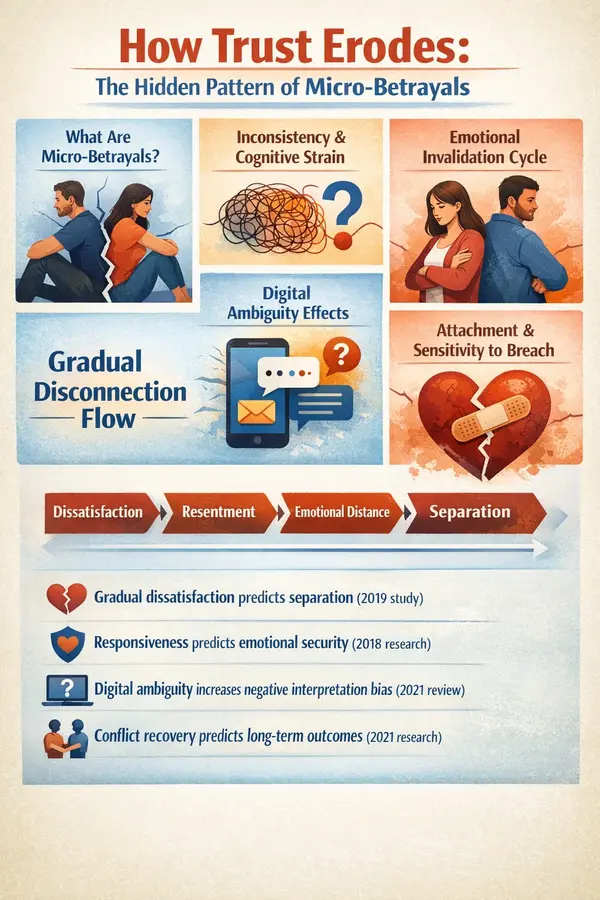
Researchers often describe relationships as operating on a cumulative pattern model. Each interaction contributes to a broader narrative about safety and reliability. In longitudinal research summarized by Lavner and Bradbury (2019) in Current Opinion in Psychology, gradual dissatisfaction often predicts later separation more strongly than sudden conflict spikes.
Early signs of trust erosion may include:
- Increased doubt about intentions
- Heightened sensitivity to ambiguity
- Reduced emotional openness
Because these shifts are subtle, they may go unnoticed until emotional distance becomes pronounced.
What Are Micro-Betrayals?
Micro-betrayals are small actions that violate relational expectations without constituting major betrayal.
Examples may include:
- Repeatedly failing to follow through on minor promises
- Withholding small but relevant information
- Minimizing a partner’s concerns
- Dismissing emotional experiences
- Flirting in ways that feel ambiguous
Individually, these behaviors may appear insignificant. Collectively, they alter perceptions of reliability.
Micro-betrayals differ from isolated mistakes. Mistakes occur occasionally and are often followed by accountability and repair. Micro-betrayals become damaging when they form patterns.
Over time, these patterns shift internal narratives from “I feel safe” to “I feel uncertain.”
Also read: The Psychology of Jealousy: Emotional Triggers and Relationship Impact
The Role of Inconsistency
Consistency is one of the strongest predictors of cognitive trust. When behavior aligns with words repeatedly, predictability increases emotional security.
Inconsistent patterns create cognitive strain:
- Mixed messages
- Unpredictable emotional reactions
- Fluctuating responsiveness
Research on attachment and emotional processes indicates that unpredictability heightens threat sensitivity, particularly in individuals with anxious attachment tendencies (Overall & Simpson, 2019, Current Opinion in Psychology.
Even minor inconsistencies, when repeated, accumulate into perceived instability.
Trust erosion is often less about overt wrongdoing and more about gradual unpredictability.
Emotional Invalidation and Subtle Dismissal
Emotional invalidation is a powerful driver of trust erosion.
Invalidation may include:
- Minimizing emotional reactions
- Responding defensively to vulnerability
- Changing the subject during difficult conversations
- Labeling concerns as “overreactions”
Research by Reis and Clark (2018) in Emotion demonstrates that perceived partner responsiveness strongly predicts satisfaction and emotional security.
When emotional disclosures are repeatedly dismissed, partners may reduce vulnerability over time. This reduction weakens emotional intimacy and gradually decreases trust.
Trust depends not only on reliability, but on feeling heard.
Digital Micro-Betrayals in Modern Relationships
Digital communication has introduced new forms of ambiguity.
Digital micro-betrayals may include:
- Hiding certain online interactions
- Selective transparency about messages
- Engaging in ambiguous public comments
- Inconsistent online availability explanations
Because digital interactions lack tone and context, small discrepancies can feel larger than intended.
Over time, unresolved digital ambiguities can compound into suspicion.
Attachment Styles and Trust Sensitivity
Attachment patterns significantly influence how micro-betrayals are perceived.
Anxious Attachment
Individuals with anxious attachment are often more sensitive to small breaches. Minor inconsistencies may trigger heightened vigilance.
Avoidant Attachment
Avoidantly attached individuals may withdraw emotionally after breaches, reducing vulnerability rather than confronting concerns.
Secure Attachment
Securely attached individuals tend to interpret minor breaches more flexibly and engage in repair more readily.
Attachment differences shape whether micro-betrayals escalate into larger trust fractures.
Read more: How Attachment Styles Develop From Childhood to Adulthood
The Gradual Shift Toward Emotional Disconnection
Trust erosion often precedes visible disconnection.
Common indicators include:
- Reduced emotional sharing
- Decreased reassurance-seeking
- Parallel daily routines
- Lower emotional investment in conflict resolution
Research suggests that disengagement rather than conflict intensity is one of the strongest predictors of long-term relationship instability (Lavner & Bradbury, 2019).
Disconnection tends to occur quietly. Partners may continue functioning logistically while emotional closeness diminishes.
The shift is gradual, often marked by decreased emotional energy rather than dramatic rupture.
The Role of Repair Attempts in Preventing Erosion
Repair attempts interrupt trust erosion.
Effective repair includes:
- Acknowledgment of impact
- Behavioral correction
- Consistent follow-through
Research in Current Directions in Psychological Science (Overall & McNulty, 2021) emphasizes that conflict recovery processes strongly predict relationship outcomes.
When micro-betrayals are addressed quickly and constructively, they are less likely to accumulate.
Without repair, small breaches remain unresolved and contribute to negative relational narratives.
Cumulative Patterns vs. Isolated Incidents
Trust erosion is rarely caused by a single incident. Instead, it reflects cumulative pattern recognition.
Repeated small breaches:
- Reinforce uncertainty
- Increase negative attribution bias
- Amplify defensive cycles
Over time, partners may reinterpret neutral behavior through a lens of suspicion.
Longitudinal research consistently shows that gradual dissatisfaction trajectories predict separation more reliably than sudden, isolated crises.
Trust decline often feels like a slow drift rather than a sudden break.
Differentiating Perceived Erosion from Objective Breach
Not all perceived trust erosion stems from partner behavior.
Cognitive biases may amplify minor events. Past betrayal experiences can heighten threat sensitivity in new relationships.
Projection interpreting present ambiguity through past wounds can distort perception.
Distinguishing between:
- Repeated behavioral inconsistency
- Internal insecurity
- Digital ambiguity
requires examining patterns rather than isolated emotional reactions.
Trust erosion may reflect both relational behavior and interpretive processes.
Conclusion
Trust erosion is typically gradual. It unfolds through repeated micro-betrayals, subtle invalidations, and unresolved inconsistencies.
Key drivers include:
- Behavioral unpredictability
- Emotional dismissal
- Digital ambiguity
- Attachment-based threat sensitivity
- Lack of timely repair
Over time, these factors shift relational narratives from safety to uncertainty. Emotional disconnection often follows prolonged erosion rather than a single catastrophic event.
Understanding this gradual process clarifies that trust is maintained through consistent responsiveness and accountability. Its decline, likewise, reflects patterns small, repeated experiences that slowly reshape perception and emotional security.
Frequently Asked Questions
1. What is trust erosion in a relationship?
Trust erosion refers to the gradual weakening of emotional safety and reliability expectations over time. It typically occurs through repeated small inconsistencies or unresolved issues rather than a single major betrayal.
2. What are micro-betrayals?
Micro-betrayals are small actions that subtly violate relationship expectations, such as broken minor promises, emotional dismissal, secrecy, or inconsistent communication. Individually they may seem minor, but repeated patterns can weaken trust.
3. How is trust erosion different from infidelity?
Infidelity is usually a clear, significant breach of trust. Trust erosion often develops slowly through accumulated micro-breaches, emotional invalidation, and ongoing inconsistency rather than one dramatic event.
4. Can trust erode even if there is no cheating?
Yes. Trust can decline due to repeated unpredictability, emotional dismissal, or unresolved tension, even in the absence of physical or emotional infidelity.
5. How do attachment styles influence trust erosion?
Individuals with anxious attachment may be more sensitive to small inconsistencies, while avoidant attachment may lead to emotional withdrawal after minor breaches. Secure attachment is generally associated with greater recovery after small ruptures.
6. Does digital behavior contribute to trust erosion?
Yes. Ambiguous online interactions, hidden communication, or inconsistent digital transparency can increase uncertainty and negative interpretation bias, especially when trust is already fragile.
7. What are early signs of gradual disconnection?
Early signs may include reduced vulnerability, decreased reassurance-seeking, less emotional sharing, and growing parallel routines rather than shared experiences.
8. Can small unresolved issues accumulate over time?
Yes. Repeated minor breaches that are not acknowledged or repaired can create cumulative emotional strain and shift perceptions of reliability and safety.
9. How does emotional invalidation affect trust?
Repeated dismissal or minimization of emotions reduces perceived responsiveness. Over time, feeling unheard or misunderstood can weaken emotional trust and increase distance.
10. Is trust erosion always permanent?
Not necessarily. Trust erosion reflects patterns over time. When inconsistencies are acknowledged and followed by consistent behavioral change, emotional safety may gradually stabilize.