Valentine’s Day is widely framed as a celebration of romance: flowers, candlelit dinners, social media declarations, and carefully planned surprises. Yet for many couples, the day does not simply measure romantic intensity. Instead, it often reveals something deeper and more consequential emotional alignment.
Beneath the roses and reservations lies a quieter question: Do we experience meaning in the same way? Valentine’s Day can expose differences in expectations, attachment needs, symbolic interpretation, and communication patterns. For some couples, the day feels effortless and affirming. For others, it becomes a source of confusion, disappointment, or tension.
Rather than viewing Valentine’s Day as proof of love, it can be understood as a lens into how partners align emotionally.
What Emotional Alignment Means in Modern Relationships
Emotional alignment refers to the degree to which partners share compatible expectations, interpretations, and emotional priorities. It does not require identical personalities or identical love languages. Instead, it reflects shared meaning and mutual responsiveness.
Shared Meaning vs. Shared Performance
Many romantic holidays emphasize performance public gestures, visible effort, symbolic displays. However, research consistently shows that relationship satisfaction is more strongly associated with perceived responsiveness than with grand acts.
A 2022 review in Current Opinion in Psychology found that perceived partner responsiveness feeling understood, validated, and cared for is one of the strongest predictors of relationship well-being (Reis & Clark, 2022).
In this context, a lavish dinner matters less than whether both partners attach similar meaning to the day. Emotional alignment centers on shared interpretation rather than outward performance.
Emotional Expectations and Assumptions
Symbolic days often operate on invisible scripts. One partner may assume:
- “Of course we’re doing something special.”
- “It’s just a commercial holiday.”
- “If they care, they’ll plan something without me asking.”
When expectations are unspoken, misalignment becomes likely. Research in the Journal of Social and Personal Relationships (Vannier & O’Sullivan, 2018) highlights that unmet expectations particularly when implicit—are strongly associated with disappointment and decreased relational satisfaction.
Valentine’s Day often reveals whether couples share the same assumptions about what “special” means.
Values Congruence
Values congruence the alignment of core values between partners is consistently linked to relationship stability. A 2019 study in Personality and Individual Differences found that couples who perceived stronger alignment in values reported higher relationship satisfaction.
When one partner values symbolic celebration and the other prioritizes everyday consistency over ritual, tension can arise not because of lack of love, but because of differences in emotional framing.
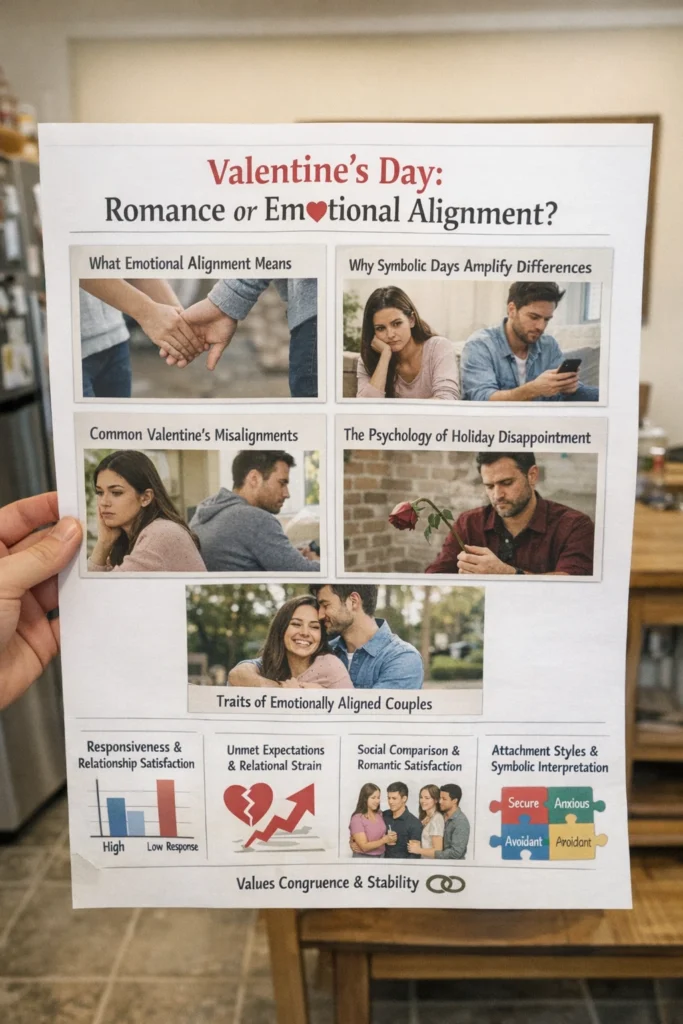
Why Valentine’s Day Amplifies Emotional Gaps
Certain days carry symbolic weight. That symbolism can intensify emotional responses.
Heightened Symbolism
Research on relationship rituals suggests that shared rituals contribute to cohesion and meaning (Fiese et al., 2002). When rituals are meaningful to one partner but neutral to the other, the gap becomes visible.
Valentine’s Day is not inherently significant; its emotional impact depends on how much symbolic weight each partner assigns to it.
Social Comparison Pressure
Social media intensifies comparison. A 2021 review in Computers in Human Behavior Reports found that romantic social comparison on social media can increase relationship dissatisfaction when individuals perceive their own relationship as lacking relative to others.
Even emotionally stable relationships can feel strained when exposed to curated displays of romance.
Attachment Activation
Emotionally meaningful dates can activate attachment systems. According to research summarized in Attachment & Human Development (Overall & Simpson, 2020), individuals with anxious attachment may experience heightened sensitivity to cues of responsiveness, while avoidantly attached individuals may downplay symbolic significance.
On Valentine’s Day, these differences can surface more sharply.
Also read: Secure Attachment: Traits, Behaviors, and Relationship Outcomes
Common Emotional Misalignments Revealed on Valentine’s Day
Effort vs. Meaning
One partner may invest visible effort a reservation, flowers, a gift while the other seeks emotional presence or verbal affirmation. Both may feel they “tried,” yet still experience disconnect.
This mismatch reflects differences in how love is expressed and interpreted, not necessarily differences in commitment.
Intimacy vs. Obligation
Some couples approach Valentine’s Day as an authentic celebration. Others experience it as obligation. When one partner feels pressure rather than connection, emotional tone diverges.
Research in Emotion (Impett et al., 2019) indicates that autonomy-supportive behaviors actions that feel freely chosen rather than pressured are associated with higher relational well-being.
When celebration feels obligatory rather than chosen, satisfaction may decrease.
Expression vs. Reception
Even when affection is expressed, it must be received in a meaningful way. Misalignment can occur when:
- One partner prioritizes verbal affirmation.
- The other prioritizes shared experience.
- Another emphasizes symbolic gifts.
The issue is not effort, but interpretive mismatch.
Symbolic Significance Discrepancy
For some, Valentine’s Day carries emotional history previous disappointments, childhood narratives, cultural meanings. For others, it is neutral.
Discrepancy in symbolic significance often feels larger than it objectively is because symbolism operates beneath conscious awareness.
The Psychological Dynamics Behind Holiday Disappointment
The Expectation Reality Gap
Expectation reality discrepancy is a well-established predictor of dissatisfaction. A 2018 study in Journal of Personality and Social Psychology found that unmet expectations especially when unspoken lead to greater relational strain than low expectations overall.
Valentine’s Day becomes a focal point for this gap.
Emotional Attribution Patterns
When expectations are unmet, individuals often attribute meaning:
- “They didn’t plan anything because they don’t care.”
- “If I mattered, they would have known.”
Research on attribution theory in relationships shows that negative attributions (interpreting behavior as intentional or dispositional rather than situational) correlate with lower satisfaction (Bradbury & Fincham, 2018 review).
Holiday disappointment can become a story about love rather than a mismatch about meaning.
Narrative Construction
Humans construct narratives from emotionally salient events. Valentine’s Day can become a symbolic data point in a larger relational story.
Isolated incidents may take on outsized meaning if they fit preexisting fears or doubts.
What Emotionally Aligned Couples Tend to Share
Valentine’s Day does not create alignment; it reveals it.
Shared Interpretation of Rituals
Emotionally aligned couples tend to share similar interpretations of what symbolic events represent. They may celebrate in elaborate or simple ways—but the framing is mutual.
Explicit Communication of Preferences
Research in Journal of Marriage and Family (2020) highlights that open emotional disclosure is associated with greater intimacy and satisfaction.
Couples who articulate what the day means to them reduce the likelihood of misalignment.
Flexibility and Mutual Adaptation
Alignment does not require sameness. It requires adaptability.
Longitudinal research in Journal of Personality and Social Psychology (Joel et al., 2020) found that responsiveness and willingness to accommodate partner preferences are central predictors of long-term relationship quality.
Emotionally aligned couples may differ—but they demonstrate flexibility in how they bridge differences.
When Valentine’s Day Reveals Deeper Compatibility Questions
Not every disappointment signals incompatibility. However, patterns matter.
Patterns vs. One-Off Events
Research consistently distinguishes between chronic patterns of low responsiveness and isolated situational lapses. Persistent misalignment around meaningful events may reflect broader differences in emotional needs.
Emotional Responsiveness Over Time
A 2019 meta-analysis in Psychological Bulletin concluded that perceived responsiveness is one of the most robust predictors of long-term relational stability.
If emotional responsiveness is consistently absent across symbolic moments, Valentine’s Day may highlight an ongoing pattern rather than a single-day issue.
Alignment Across Other Symbolic Moments
Birthdays, anniversaries, milestones—these events similarly test emotional congruence. Valentine’s Day often functions as a concentrated version of broader relational dynamics.
Reframing Valentine’s Day Through the Lens of Emotional Alignment
Rather than evaluating the day as “good” or “bad,” it can be reframed as informational.
- Did both partners experience the day similarly?
- Were expectations shared or assumed?
- Did actions feel emotionally responsive?
Valentine’s Day does not determine relational health. It offers insight into emotional alignment.
When partners interpret meaning similarly, symbolic events feel affirming. When they differ, the day may illuminate gaps in expectation, communication, or values.
Neither outcome is inherently catastrophic. Both provide data about how a relationship functions.
Conclusion
Valentine’s Day is commonly portrayed as a romantic performance. In reality, it often functions as a relational mirror.
It reflects:
- Shared or divergent expectations
- Attachment sensitivities
- Communication clarity
- Values congruence
- Responsiveness
Romance can be expressed on any day. Emotional alignment, however, is built over time through consistent attunement and shared meaning.
Valentine’s Day does not measure love. It reveals how partners define and experience it.
Frequently Asked Questions:
1. What does emotional alignment mean in a relationship?
Emotional alignment refers to the degree to which partners share similar expectations, values, and interpretations of meaningful experiences. It includes feeling understood, emotionally responsive to one another, and aligned in how affection and significance are expressed.
2. Why can Valentine’s Day create tension in otherwise stable relationships?
Valentine’s Day carries symbolic and cultural expectations that may not be equally shared. Differences in how partners define celebration, romance, or effort can highlight emotional misalignment, even when overall relationship satisfaction is high.
3. Is disappointment on Valentine’s Day a sign of incompatibility?
Not necessarily. A single unmet expectation often reflects a communication gap rather than a fundamental incompatibility. Patterns of ongoing emotional disconnect are more indicative of deeper alignment issues than one isolated event.
4. How do attachment styles influence Valentine’s Day reactions?
Individuals with anxious attachment tendencies may experience heightened sensitivity to perceived signs of responsiveness, while those with avoidant tendencies may downplay the symbolic importance of the day. These differences can shape emotional reactions to the same experience.
5. Does celebrating Valentine’s Day matter for relationship health?
Research suggests that shared rituals and perceived responsiveness matter more than the specific holiday itself. Couples who attach similar meaning to rituals—whether they celebrate elaborately or simply—tend to experience greater emotional alignment.
6. How is emotional alignment different from romance?
Romance often refers to gestures, affection, and symbolic displays of love. Emotional alignment focuses on shared meaning, mutual understanding, and consistent responsiveness over time. Romance can reflect alignment, but it does not automatically create it.
7. Can social media affect how couples feel about Valentine’s Day?
Yes. Social comparison through social media can influence perceptions of relationship quality. Exposure to curated displays of romance may amplify dissatisfaction if couples compare their private experiences to idealized public portrayals.
8. What are common signs of emotional misalignment during holidays?
Common indicators include mismatched expectations, differing levels of symbolic importance, feelings of obligation rather than authenticity, or interpreting neutral behavior as rejection. These experiences often point to differences in emotional framing rather than lack of care.
9. Can emotional alignment change over time in a relationship?
Yes. Emotional alignment is not fixed. As partners grow, experience life transitions, or renegotiate shared meaning, their expectations and emotional priorities can shift. Ongoing communication and responsiveness often influence whether alignment strengthens or weakens over time.
10. Why do symbolic holidays feel more emotionally intense than ordinary days?
Symbolic holidays concentrate cultural meaning, personal expectations, and social comparison into a single moment. This combination can amplify emotional reactions, making alignment or misalignment more noticeable than it might be during everyday interactions.