Valentine’s Day is often framed as a celebration of love, connection, and romance. Yet for many couples, it becomes a surprisingly uncomfortable moment one that brings tension, disappointment, or emotional distance to the surface. This contrast can feel confusing. A holiday designed to celebrate relationships instead exposes cracks that may have gone unnoticed the rest of the year.
This pattern is not accidental. Valentine’s Day functions less as a cause of relationship problems and more as a spotlight. Its symbolic weight, cultural expectations, and emotional intensity tend to amplify dynamics that already exist beneath the surface.
Valentine’s Day as a Relationship Mirror
Unlike ordinary days, Valentine’s Day carries a shared cultural script. It invites reflection sometimes unintentionally on the state of a relationship. Couples are prompted to assess effort, intimacy, and emotional connection, even if they do not consciously intend to do so.
Because of this, the day often acts as a mirror rather than a test. It reflects existing patterns: how partners communicate, how they express care, and how aligned they feel. When things are already strained or ambiguous, the reflection can feel unsettling.
The Weight of Expectations and Unspoken Assumptions
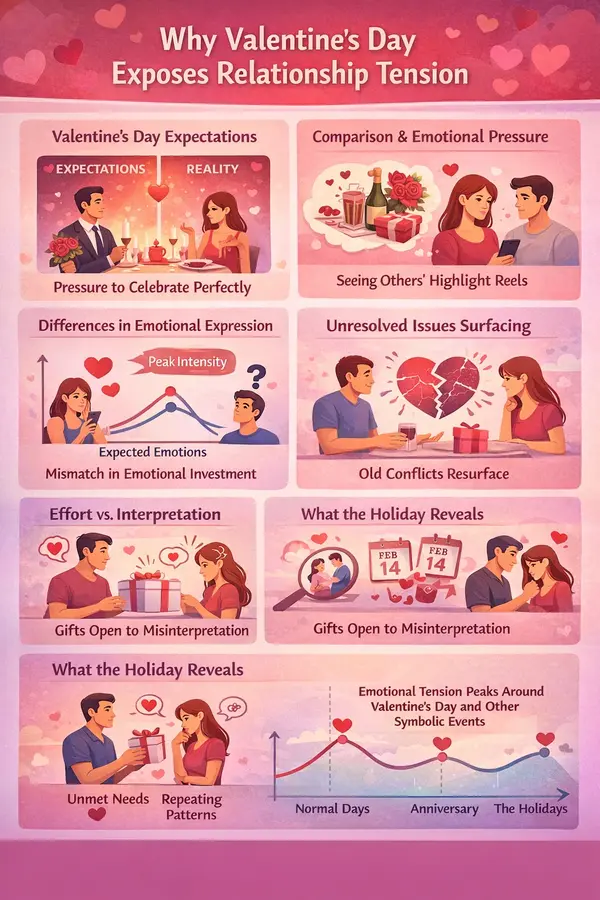
Valentine’s Day is filled with expectations, many of which are never openly discussed. Social norms suggest certain gestures thoughtfulness, romance, acknowledgment without clearly defining what those gestures should look like.
When partners hold different expectations, disappointment can arise even in the absence of conflict. One person may see the day as symbolic and emotionally meaningful, while the other may view it as optional or commercially driven. Without explicit conversation, these differences remain assumptions until the day itself brings them into focus.
The tension often comes not from what happens, but from what was quietly expected to happen.
Emotional Contrast and the Comparison Effect
Valentine’s Day intensifies comparison. Images of couples celebrating, exchanging gifts, or expressing affection can create a sharp contrast with one’s own experience. Even individuals who rarely compare their relationships may feel the impact of this collective narrative.
This contrast does not necessarily create dissatisfaction, but it can magnify existing doubts. If someone has already been questioning emotional closeness, effort, or reciprocity, Valentine’s Day can make those concerns feel more urgent or undeniable.
Differences in Emotional Expression
Another reason hidden issues surface is that Valentine’s Day highlights differences in how partners express care. Some people value symbolic gestures and planned moments, while others prioritize consistency and everyday presence.
On a day that emphasizes visible expressions of affection, these differences become more noticeable. What might normally be interpreted generously can feel dismissive or mismatched under the pressure of a shared occasion. The issue is often less about the gesture itself and more about what it is perceived to represent.
Unresolved Issues Rising to the Surface
Emotionally charged moments tend to bring unresolved issues with them. Valentine’s Day can amplify lingering frustrations, unspoken resentments, or unresolved conflicts that have been set aside.
Small disappointments may feel larger because they tap into broader emotional themes—unappreciated, overlooked, or emotionally distant. The holiday does not create these feelings, but it can lower the threshold for them to emerge.
Effort as a Measure of Investment
Valentine’s Day is frequently interpreted as a signal of effort and prioritization. For some, how a partner approaches the day becomes a proxy for how invested they are in the relationship overall.
This can be problematic, as intention and interpretation do not always align. A partner may feel their everyday actions already demonstrate care, while the other looks to the holiday for explicit acknowledgment. When these perspectives clash, it can highlight deeper differences in how love and commitment are understood.
Read more: What Valentine’s Day Really Reveals About Your Relationship
Attachment Triggers and Emotional Sensitivities
Symbolic moments like Valentine’s Day can activate attachment-related sensitivities. Feelings around reassurance, closeness, or fear of neglect may become more pronounced.
For individuals who are already sensitive to imbalance or emotional uncertainty, the day can intensify self-questioning and reassurance-seeking. This does not mean something is “wrong,” but it does suggest that the relationship context makes these sensitivities more visible.
When Celebration Highlights Structural Issues
Not every Valentine’s Day disappointment signals a serious problem. However, when dissatisfaction repeats year after year, it may point to structural issues misaligned expectations, communication gaps, or differing emotional needs.
In these cases, the holiday serves as a recurring checkpoint. The discomfort is less about the date itself and more about what it consistently reveals.
Self-Reflection Within the Relationship
Valentine’s Day can also prompt individual self-reflection. Emotional reactions whether disappointment, indifference, or pressure often provide insight into personal needs and values.
Understanding one’s own response can be as informative as evaluating a partner’s behavior. It allows for awareness without blame, and curiosity rather than immediate judgment.
Valentine’s Day as Information, Not a Verdict
Ultimately, Valentine’s Day does not create relationship problems. It exposes patterns that already exist by placing them under emotional and cultural magnification.
Seen this way, the holiday becomes less of a verdict on the relationship and more of a source of information. It highlights alignment, misalignment, and areas that may benefit from attention. What matters most is not the day itself, but what it reveals about the relationship beyond it.
Frequently Asked Questions
1.Why does Valentine’s Day make relationship issues more noticeable?
Valentine’s Day places symbolic emphasis on romance, effort, and emotional connection. This heightened focus can make existing patterns such as unmet expectations or emotional distance more visible than they feel during everyday life.
2. Does Valentine’s Day cause relationship problems?
Valentine’s Day does not create problems on its own. It tends to amplify dynamics that already exist by encouraging comparison, reflection, and emotional evaluation.
3. Why do expectations feel stronger on Valentine’s Day?
Cultural narratives around Valentine’s Day suggest certain meanings and gestures without clearly defining them. When expectations remain unspoken, the day can expose differences in how partners interpret its significance.
4. Why do small disappointments feel bigger on Valentine’s Day?
Emotionally charged moments lower tolerance for ambiguity. A minor letdown may connect to broader feelings about appreciation, effort, or emotional security, making it feel more significant.
5. How does comparison affect relationships on Valentine’s Day?
Exposure to idealized portrayals of romance can heighten awareness of perceived gaps in one’s own relationship. This comparison often magnifies existing doubts rather than creating new ones.
6. Why do differences in effort stand out more during holidays?
Symbolic occasions concentrate meaning into a short window. Differences in how partners express care become more noticeable when a shared cultural script emphasizes visible effort.
7. Can Valentine’s Day reveal long-term relationship patterns?
When dissatisfaction or tension repeats across multiple Valentine’s Days, it may point to ongoing misalignment in expectations, communication, or emotional needs rather than a one-time issue.
8. Why do some people feel pressure or anxiety around Valentine’s Day?
The holiday can activate sensitivities related to validation, reassurance, or emotional balance. These reactions often reflect personal or relational context rather than the holiday itself.
9. Is feeling disappointed on Valentine’s Day a sign of relationship trouble?
Disappointment alone does not indicate a serious problem. It becomes more meaningful when paired with recurring feelings of being overlooked, disconnected, or emotionally uncertain.
10. What can emotional reactions to Valentine’s Day reveal?
Personal responses whether excitement, indifference, or discomfort often highlight underlying values, expectations, and emotional priorities within the relationship.